
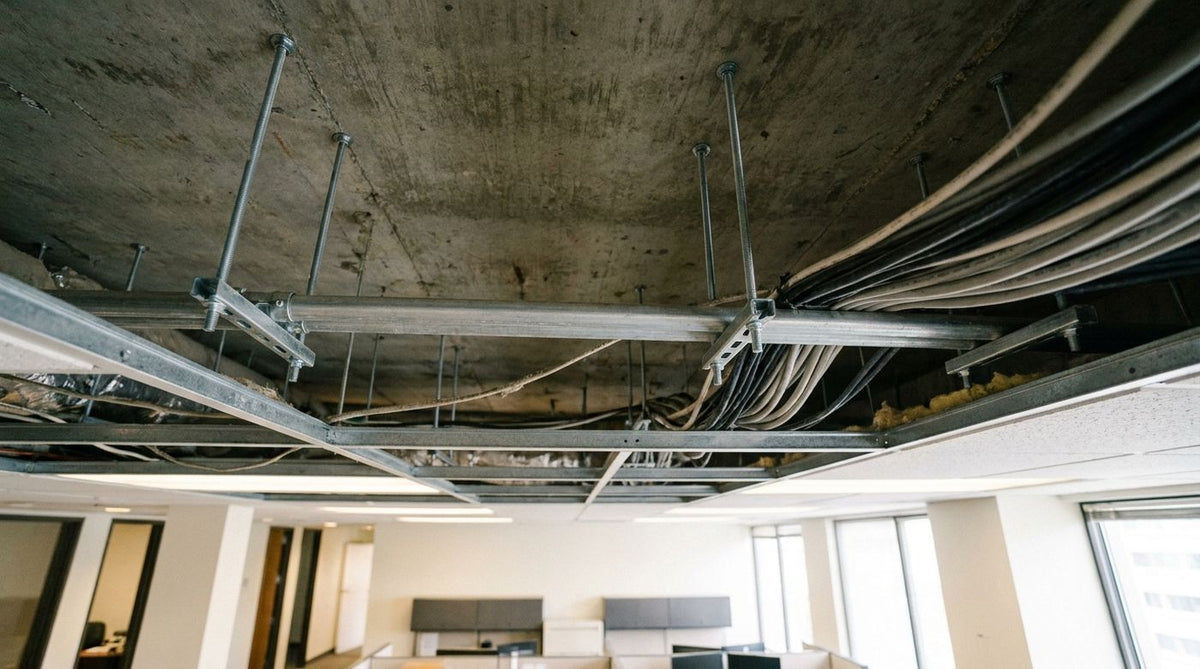
Above the grid is where wiring goes to be forgotten. Nobody looks at it after the tiles go back, the next trade runs whatever they like through the same cavity, and ten years of tenant fit-outs pile abandoned cable on top of the T-bar. The instinct that "it's just above the tiles, nobody sees it" is exactly backward. Concealed is not the same as unimportant, and in a return air plenum the space itself is part of the fire protection strategy of the building.
What makes a ceiling a plenum
Section 300.22 divides air-handling spaces into a few categories, and the distinctions matter more than the vocabulary people use on site. There are ducts specifically fabricated to move environmental air, which are the most restrictive. There are other spaces used for environmental air — the classic open ceiling cavity that a building uses as a return path back to the air handler. And there is everything else, which is a plain concealed space with ordinary rules.
That middle category is where the confusion lives, because two ceilings that look identical from a ladder can be in different categories. If the HVAC return is fully ducted, with sheet metal running from the return grille all the way back to the unit, the cavity above the tiles is not an air-handling space. Ordinary wiring methods apply. If the return grille is just a boot dumping into the ceiling cavity and the air handler pulls from that cavity, it is a plenum, and the restrictions apply to everything in it.
The way to find out is to stick your head up and follow the return. Not to ask the GC, who will say whatever keeps the job moving, and not to assume from the building type. Open-plenum return is extremely common in strip retail, office fit-outs and small medical suites — precisely the buildings where a small electrical contractor is doing a two-week job without a mechanical engineer on speed dial.
What is allowed up there
The logic behind the list is worth understanding, because then you do not have to memorize it. Anything burning in that cavity is feeding smoke directly into the air the building is breathing, at the rate the fan is moving it. So the permitted methods are the ones that do not contribute much smoke or flame: metallic raceways and metal-jacketed cables, essentially. EMT, IMC and rigid, metal wireway and surface metal raceway with covers, MI and AC cable, MC cable without a nonmetallic outer jacket, and flexible metallic wiring methods in the short lengths the Code allows for connections.
What is out is the stuff that is cheap and fast: NM cable, ENT, nonmetallic wireway, and MC with a plastic jacket over it. Equipment in the space — luminaires, transformers, drivers, junction boxes with something live in them — has to be suitable for the location, which in practice means listed for use in an air-handling space or it does not go up there.
The other half of the problem is low voltage, and it is the half that fails inspection most often on tenant work. Communications, Class 2 and 3, and fire alarm cable all have plenum-rated versions, and they cost real money next to the riser-rated equivalent. A box of the wrong cable pulled through an open plenum by whoever was cheapest is a common and genuinely dangerous find. The cable types are set out in Articles 725, 760, 800 and 805, all of which you can read through NFPA free access with a free account.
Why the fire behavior is the actual argument
It is easy to treat the plenum rules as a listing technicality — same copper, more expensive jacket. The research on what happens to energized cable in a real fire is worth a read before you make that argument to a customer. UL's Fire Safety Research Institute tested a range of cord and cable types, including ordinary 12-2 and 12-3 NM-B, under flashover fire conditions with the conductors energized, and looked at how the arcing faults that develop interact with the breaker, GFCI and AFCI protecting them. The short version is that cable under fire attack does not fail in the tidy way people assume, and overcurrent protection is not the backstop it feels like.
Now put that behavior inside a cavity whose job is to move air to every occupied room in the building. That is why the jacket material is not a technicality. NFPA's non-home electrical fires report is the free national picture if you want the wider context.
Support, and the other trades
The second-most-common finding above a grid ceiling has nothing to do with the plenum rules. It is support. Raceway and cable have to be independently supported by the building structure. The suspended ceiling grid and the wires holding the grid up are not it, and hanging a run off a grid support wire with a zip tie is a correction notice even in a plain concealed space. Where a ceiling assembly is designed to allow it, the independent support wires are typically installed and identified separately from the grid wires, which is a detail worth confirming rather than assuming.
If a ceiling tile came down and took your homerun with it, it was never supported.
Then there is the pile of dead cable. Accessible abandoned communications and Class 2 cable is required to be removed, and on a twenty-year-old office fit-out the volume of it can be genuinely alarming — enough fuel load in a return plenum to change how a fire behaves. Nobody prices it, and nobody wants to be the one who tells the tenant. It is still your finding, and it is worth documenting in writing even if you do not get the work to pull it out.
Finally, remember that the ceiling is shared. Sprinkler, mechanical and data all have claims on the same six inches, and the one who gets there last loses. If you are running conduit above a grid, walking the route once with the other foremen before you hang the first strut costs an hour and saves a week.
Chapter 3 wiring methods are the material most journeymen think they already know and most commonly get wrong on a plan review. Our Illustrated Guide to Understanding the National Electrical Code, Volume 1 goes through the wiring method and support requirements with the ceiling cases drawn, which tends to settle arguments faster than a page of text.