
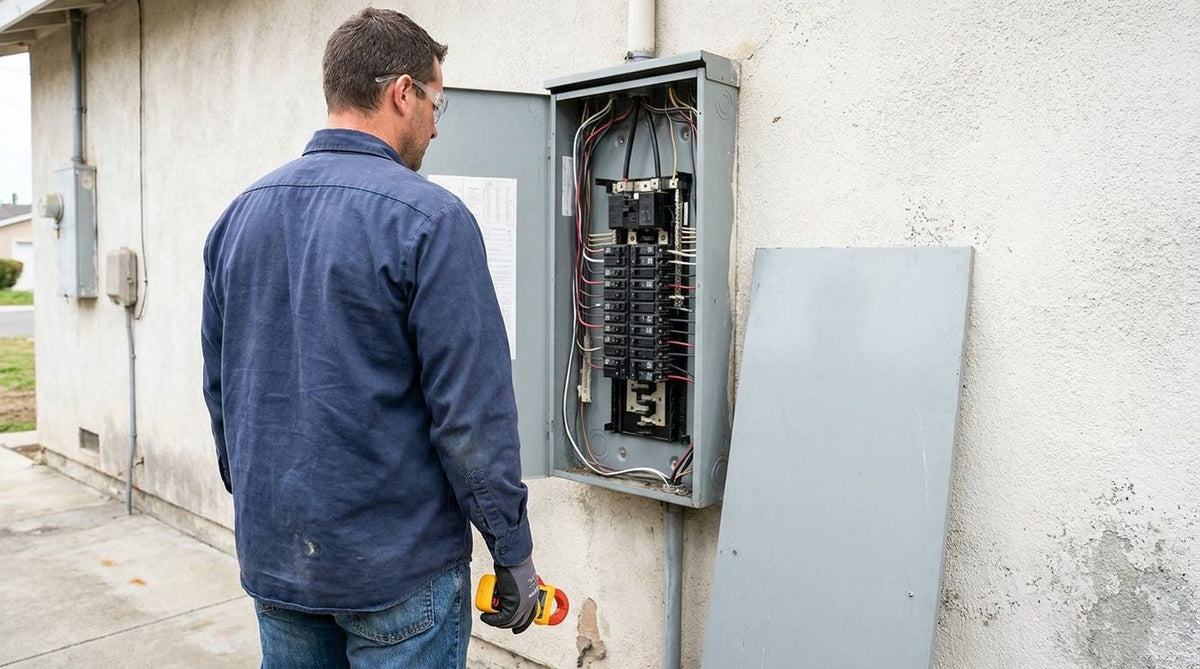
Almost everything written about arc flash assumes you work in a plant. Incident energy studies, labeled switchgear, 40 cal suits, a safety department with a budget. If your week is service changes, panel swaps, restaurant kitchens and small office tenant fits, that material reads as somebody else's problem and quietly trains you to dismiss the hazard.
OSHA's own arc flash page disposes of that in one line, and it is the line worth carrying around.
"Low voltage is not low risk." — OSHA, Electric-Arc Flash Hazards
The same page states that even 120/208V can create arcs with more than enough energy to burn exposed skin, ignite flammable clothing and cause catastrophic or fatal injuries, and that incident energy depends mostly on available current, clearing time and your distance from the arc — not on voltage.
What that means at a 200-amp service
Voltage determines whether an arc will start. Current and time determine how much energy it dumps into the space you are standing in. On a residential or light-commercial service, the voltage is low, but two other things are frequently unhelpful.
The available fault current at the service of a house on a modern pad-mounted or pole transformer is not small. A 25 kVA transformer with a short secondary drop can deliver several thousand amperes into a bolted fault, and the strip mall with a 500 kVA transformer thirty feet away is a different animal again.
More importantly, the thing that will clear that fault on the line side of your main is the utility's fuse or the service equipment itself, and neither is fast in the way a current-limiting device is fast. Clearing time is the multiplier. An arc that takes six cycles to clear delivers roughly three times the energy of one that clears in two. The most dangerous place in a small building is the line side of the main disconnect, which is exactly where people work while the meter is still in.
The honest numbers on frequency: arc flash accounts for a small share of electrical fatalities. ESFI's 2011–2024 compilation attributes 2 percent of electrical fatalities to arc flash, against 49 percent from overhead power line contact. That is not a reason to relax. Arc flash is a burn-injury and disability hazard far more than a mortality hazard; the same source counts 5,180 non-fatal electrical injuries with days away from work across 2023 and 2024. Those are the months off work, the grafts and the career endings that do not appear in fatality statistics.
What 70E asks of a two-man shop
NFPA 70E is a consensus standard, not law, but OSHA's general duty clause and the work-practice rules in 29 CFR 1910 Subpart S give it teeth. 70E was originally developed at OSHA's request, and OSHA points to it directly from its own arc flash guidance. The practical requirements, stripped of the industrial framing:
- Establish an electrically safe work condition. This is the whole standard in one phrase. De-energize, lock out, verify absent voltage with a tester you proved works before and after. 70E treats energized work as something requiring justification, not something requiring PPE.
- Understand what counts as de-energized. OSHA's position is unambiguous: conductors that have been de-energized but not locked out or tagged are treated as energized parts. Killing the breaker is not lockout.
- Do a risk assessment before you open the cover. Shock and arc flash are assessed separately. On a small job this is thirty seconds of thought, not a document, but it has to actually happen.
- Wear arc-rated clothing, and wear it properly. OSHA notes that most arc flash burn injuries come from the arc igniting flammable clothing rather than from the arc itself, and that meltable undergarments under arc-rated outerwear are a hazard in their own right. A polyester shirt under a cotton overshirt is the worst of both.
- Nobody works alone on energized equipment. The crawl-space and panel-room cases in the NIOSH record are full of people who were found rather than rescued.
The single most common violation in small-shop residential and light-commercial work is not missing PPE. It is pulling a deadfront with the main on because the homeowner wants the freezer running, and doing it in a T-shirt.
Incident energy, without buying the standard
IEEE 1584 is the calculation method behind every arc flash label you have seen. The 2018 edition is the current one and it is paywalled, and its equations are copyrighted — you will not find them reproduced legitimately, and anyone reproducing them is doing you no favors.
What is free is the implementation. IEEE DataPort hosts open-access arc flash incident energy and arcing current calculators built on the 2018 model. If you can get an available fault current figure from the utility and a clearing time from the device curve, you can put a real number on a real panel instead of guessing.
Two limits on that, stated plainly. IEEE 1584's model has a defined range of applicability and low-voltage panelboards near its lower boundary behave awkwardly in it. And a calculation is only as good as the fault current and clearing time you fed it, both of which are estimates on most small jobs. The output is a decision aid, not a certificate.
What is actually worth doing
For a residential and light-commercial outfit, the useful program is short. Ask the utility for available fault current at the services you work on repeatedly; they will usually tell you. Buy arc-rated shirts and wear them as your normal work clothes rather than as ceremonial equipment. Own a decent meter and a proving unit and use the test-verify-test sequence every time, without exception. Get a face shield rated for arc flash and keep it in the van, not in the shop. And treat the line side of any service as the highest-energy place you will stand all year, because it usually is.
None of that is expensive and none of it requires an engineering study. It requires deciding that the hazard applies to you.
Understanding where the code's own requirements sit alongside all this — service equipment, overcurrent protection, disconnect location — is what our Illustrated Guide to Understanding the National Electrical Code, Volume 1 covers, and the code text itself is available through NFPA's free access portal with a free account.