
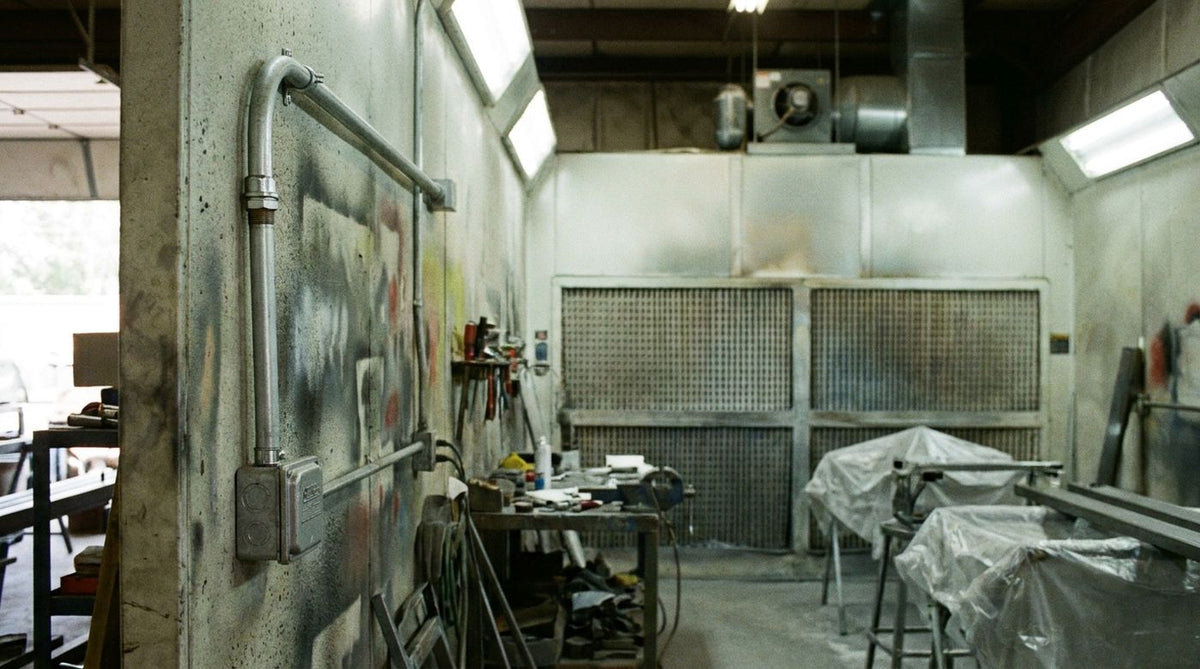
Most of us go years without touching a classified area. Then a service call lands in a spray booth, or a feed mill wants a bin level sensor moved, and the work looks exactly like the work you do every day. Same conduit, same terminations, same meter. That is the trap. Nothing about the physical task tells you the rules just changed underneath you.
Article 500 is not a wiring method. It is a framework for describing an atmosphere, and everything downstream follows from that description. Get the description wrong and every correct-looking decision after it is also wrong.
What the classification is actually describing
The system asks two questions: what is in the air, and how often is it there.
The first question gives you the Class. Class I is flammable gas, vapor or liquid — solvents, propane, gasoline, hydrogen. Class II is combustible dust — grain, sugar, flour, coal, aluminum, plastic. Class III is ignitible fibers and flyings, the textile and woodworking case. These are not three flavors of the same hazard. A dust atmosphere behaves nothing like a vapor atmosphere: it settles out of the air, it accumulates in layers on top of horizontal surfaces, and those layers insulate equipment so it runs hotter than its rating assumed. That is why Article 502 is a different animal from Article 501, and why dust-ignitionproof and explosionproof are two different listings that are not substitutes for one another.
The second question gives you the Division. Division 1 means the hazardous atmosphere is expected during normal operation — inside the booth while it is spraying, in the vapor space of a tank, around an open transfer point. Division 2 means it shows up only when something has gone wrong: a ruptured line, a failed exhaust fan, a gasket that let go. Division 2 is the one people misjudge, because "nothing is leaking today" is not the test. The test is what the space looks like the day something does.
Articles 505 and 506 give you the parallel Zone system — Zone 0, 1 and 2 for gas, Zone 20, 21 and 22 for dust — which slices the same problem more finely and is what you will see on drawings from firms that work internationally. Both systems live in the Code. They are not interchangeable line for line, and mixing vocabulary between them on a submittal is a fast way to lose an afternoon. You can read the article structure yourself through NFPA's free access portal, which needs a free account.
Somebody classifies the area, and it is rarely you
This is the step that gets skipped. Area classification is an engineering exercise built on the process itself: what material is handled, how much, at what pressure and temperature, how the space is ventilated, and where the credible release points are. The Code expects that work to be documented and available to the people who design, install and inspect. It does not expect the installing electrician to stand in the room and form an opinion.
So the first question on a classified job is not what fittings to order. It is where the area classification drawing is. If nobody can produce one, you have found the real problem, and it is not an electrical problem yet. Plenty of small plants have never had one made. The owner assumes the last contractor knew. The last contractor assumed the same about the one before him.
With no classification document, you are not installing to a standard. You are guessing in a room that can take the wall out.
A spray booth and a grain leg are not the same job
Article 516 covers spray application, dipping and coating. The classified volume is not just the inside of the booth — it extends out from the openings and down toward the floor, because solvent vapor is generally heavier than air and rolls. The exact envelope depends on whether the booth is open or enclosed and how it is ventilated, which is precisely why the drawing matters. The practical consequences are seals within the required distance of the boundary, listed luminaires with the right temperature code, and no ordinary junction box quietly living six feet off the booth face because that is where it was convenient.
Grain handling is Article 502 territory, Group G dust, and the failure mode is different. There is no vapor cloud to ventilate away. There is a layer of dust on top of every conduit, every fixture, every motor, and a suspended cloud only when something is being moved or cleaned. Equipment is selected so its surface temperature stays below the ignition temperature of both the cloud and the layer, and the whole design assumes housekeeping that may or may not happen. Seal fittings keep dust out rather than containing an explosion. If you have been treating Class II like Class I with different paperwork, that is the gap.
Repair garages, fuel dispensing and bulk storage each have their own article too — 511, 514, 515 — and each defines its classified volume in terms of distance from a dispenser, a pit, or a vent. The number of electricians who have installed a receptacle inside a fuel dispensing boundary because it was on the architectural plan is not small.
The tells that you are out of your depth
Being honest about this is cheap. Being wrong is not. Electricians already die at a rate of 2.89 per 100,000 workers against 0.11 across all occupations, and that baseline is ordinary work. Classified areas add a hazard that does not care how good your bends are.
- Nobody can hand you an area classification drawing, or the one you get is undated and unsigned.
- You are reading the Group and temperature code off a nameplate for the first time on this job.
- You cannot say from memory why a seal goes where it goes, or what it is sealing against.
- The existing installation already has non-listed equipment in it and the customer wants you to "match what's there."
- Somebody is telling you the area was reclassified but cannot say who did it or when.
None of that means refuse the work. It means scope it honestly, price the engineering, and put the classification question in writing before you order material. OSHA's general industry electrical rules in 29 CFR 1910 Subpart S lean directly on this part of the NEC, so the exposure is not only to the AHJ. And if you want to understand why any of these rules exist rather than just what they say, the narrative investigations in the NIOSH FACE case database are the closest thing the trade has to a literature.
If classified work is starting to appear in your bids rather than once a decade, the special occupancy articles are worth owning properly rather than skimming. Our Illustrated Guide to the NEC, Volume 2 covers Articles 500 through 760 with the drawings that make the classified boundaries make sense on a page instead of in your head.