
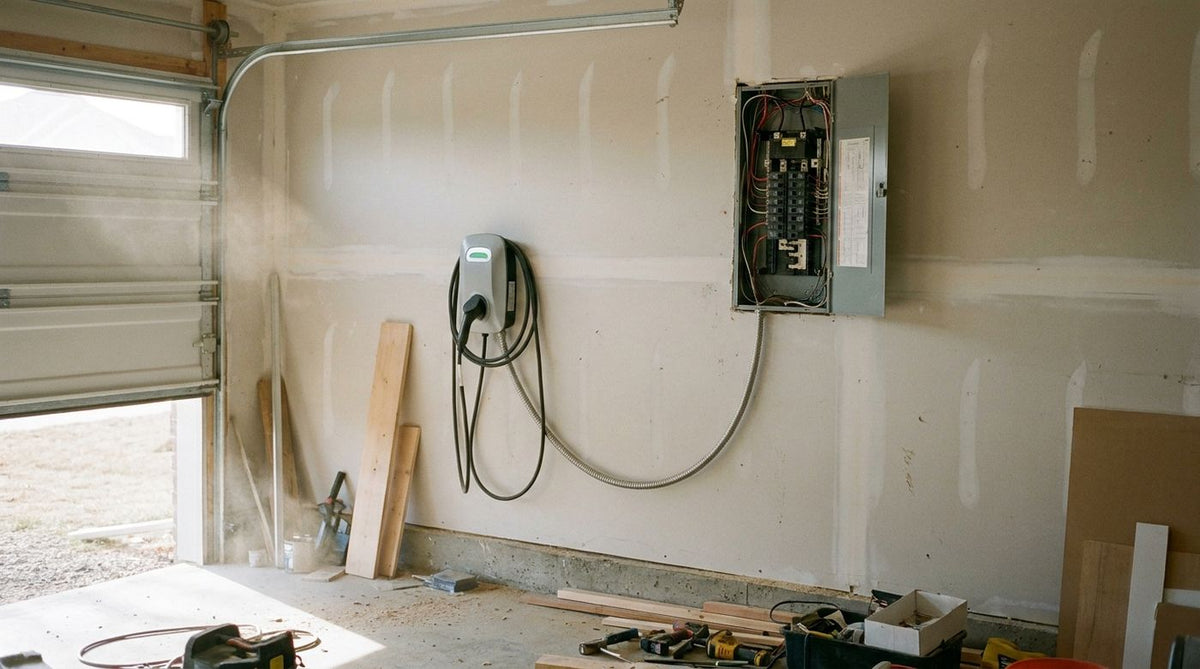
The customer wants a 60-amp circuit for a wall charger in the garage. The house has a 100-amp service, gas heat, gas water heater, gas range, and a load calculation that says there is room. The salesman at the dealership told them they need a 200-amp service. Both of those can be true depending on which calculation you run, and the answer you give decides whether this is a Saturday morning job or a five-thousand-dollar project with utility coordination attached.
Electric vehicle supply equipment is the most common reason a residential electrician now has to do a real load calculation, and it is unusual enough to catch people who have been doing service changes for twenty years.
Continuous load, and why it is not negotiable
A continuous load is one expected to run at its maximum for three hours or more. Almost nothing in a house qualifies. A dryer runs an hour. A range runs in bursts. An air conditioner cycles. A car charging from twenty percent to full on a Level 2 charger runs flat out for six to eight hours and does not vary, which is precisely the thermal case the continuous load rule was written for.
Article 625 treats EVSE as continuous, which means the branch-circuit conductors and the overcurrent device are sized at 125 percent of the equipment rating. A 48-amp charger needs a 60-amp circuit. A 40-amp charger needs 50. This is not a correction for conductor bundling or ambient temperature, which may also apply on top of it. It is the plain 125 percent that Article 210 applies to any continuous load, and it is why the breaker looks oversized next to the nameplate.
The same 125 percent lands in the service calculation. The Article 220 methods bring EVSE in at its continuous value, and unlike a range or a dryer it gets no demand factor, because the assumption behind demand factors is diversity and a car charging overnight has none.
Running the calculation that actually answers the question
For an existing dwelling, the standard method in Article 220 adds up connected load with demand factors and usually produces a number that sends you to a service upgrade. The optional method for dwellings often produces a smaller number for the same house. Both are legal. Which one you use is your choice, and you should run whichever one you intend to submit before you quote.
The method most residential electricians underuse is the existing-dwelling calculation built on maximum demand. Where a house has a twelve-month record of actual peak demand, or where a recording meter is installed for a qualifying period, the calculation can be based on measured maximum demand plus the new load at 125 percent, rather than on connected load. On an older house with a large nominal connected load and modest real usage, that regularly turns an apparent service upgrade into a spare breaker. It requires data and it requires the AHJ to accept it, and it is worth having the conversation.
- Run the calculation before the site visit ends. Quoting an EVSE install without one is how you end up eating a service change.
- A 100-amp service is not automatically disqualifying. A gas-heated house with gas appliances frequently has room for a 40-amp charger.
- All-electric houses with heat pumps and induction ranges are the ones that genuinely need capacity, and they are increasingly common.
- The service drop and the meter socket are separate questions from the panel. Check both before you promise anything.
What energy management changes
The interesting development is that the code now lets you solve the problem with control instead of copper. An energy management system under Article 750, applied through the allowances in Article 625, can limit the total load on a service or feeder so the calculation is done against the controlled maximum rather than the sum of the connected equipment.
In practice that takes three forms. A load-shedding relay drops a non-essential circuit, typically the dryer or the range, while the charger is drawing. A current-sensing controller throttles the charger itself down from 48 amps to whatever headroom exists at that moment. A smart panel does the same thing at the busbar with visibility on every branch. All three let a 100-amp service carry a charger a static calculation would refuse, and all three require listed equipment and a label describing the controlled load. An ad-hoc timer is not an energy management system.
There is a second reason to care, beyond capacity. EVSE circuits are the highest sustained-current residential branch circuits most houses will ever have, and sustained current finds bad terminations. The USFA counted 23,700 residential fires from electrical malfunction in 2023, with 305 deaths, 800 injuries and $1.50 billion in loss. Loose lugs and back-stabbed connections that survived thirty years of intermittent loads do not survive eight hours a night at full rating. Torque the terminations to the listed values, and check the panel main lugs while you are in there.
Which edition applies matters here more than in most areas, because Article 625 and the energy management allowances have moved fast. IAEI publishes a state-by-state NEC adoption table with effective dates, and the code is readable through NFPA's free access portal with a free account.
Load calculations are the single largest failure area on licensing exams: Texas reports a 20.56 percent pass rate on the journeyman calculations paper for FY2025. The journeyman exam prep guide works the standard, optional and existing-dwelling methods side by side on the same house, and Volume 1 of the Illustrated Guide to Understanding the National Electrical Code covers Article 625 with the energy management allowances alongside it.