
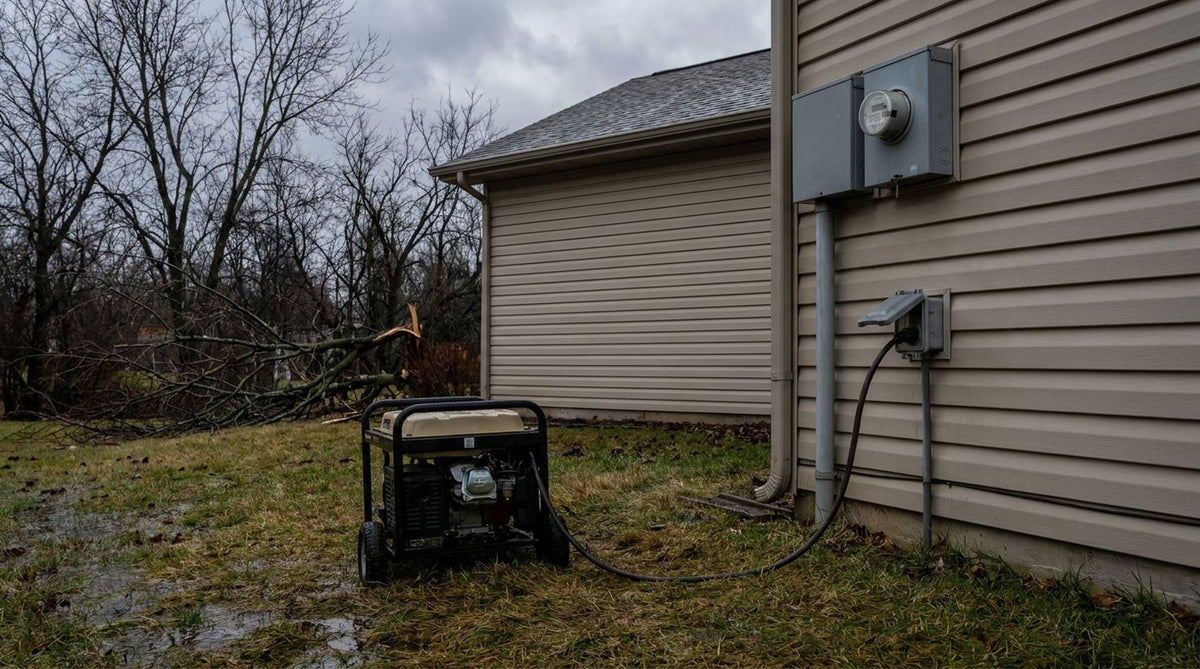
Every winter storm produces the same conversation. Somebody's uncle has a cord with a male plug on both ends, he backfeeds the dryer receptacle from a portable generator, he kills the main first, and it has worked fine for nine years. The counterargument is not that it is against code. The counterargument is that when it goes wrong, it goes wrong for somebody who is not in the house and never agreed to the risk.
A generator connected to premises wiring with no transfer equipment puts its output on the building's conductors. If the main breaker is open, the generator feeds the house and nothing else. If the main is closed, or gets closed, or was never opened, the generator feeds the house and the service conductors and the utility transformer. That transformer works in both directions. A few hundred volts on its secondary comes back out of the primary as several thousand, on a line a crew has tested, grounded and declared dead.
What the record actually says
NIOSH investigated a fatality in Puerto Rico that shows the mechanism exactly, and it is worth reading rather than summarizing away. A construction crew was assigned to correct a malfunction on a de-energized three-phase powerline. On arrival they found one of the three phases broken and lying on the ground. The supervisor instructed one of the linemen to relocate the damaged phase on the crossarm to better balance the load. As he climbed, he was assured by the supervisor that the powerlines had been de-energized. When he attempted to relocate the damaged line he contacted another phase, was shocked, and slumped backwards, prevented from falling by his safety belt. The report records that the powerlines at the worksite had been energized by backfeed electrical energy from a portable gas generator being used on the circuit. The case is NIOSH FACE 90-05.
Nothing in that account involves an unusual generator or an exotic failure. A portable machine on the circuit, a crew working lines they had every reason to believe were dead, and a man who was told they were dead.
Overhead power lines remain the largest single category in occupational electrical deaths. ESFI's compilation of 2011 to 2024 data attributes 49 percent of workplace electrical fatalities to contact with overhead power lines, and shows electricians dying at 2.89 per 100,000 against 0.11 across all occupations. BLS counted 142 fatal injuries from exposure to electricity in 2024, up from 130 in 2023.
What a listed transfer switch actually does
A transfer switch is not a convenience item. It is a mechanical guarantee that two sources can never be connected to the same conductors at the same time. In a break-before-make switch the contacts are physically linked so the utility contacts must open before the generator contacts can close. There is no sequence of operator error that puts both on at once, because the linkage does not permit it. That is the difference between a procedure and an interlock, and procedures fail.
The code recognizes a short list of legal arrangements, and they all come down to the same guarantee:
- A listed transfer switch, manual or automatic, serving all or part of the load.
- A listed interlock kit for that specific panelboard, physically preventing the main and the generator breaker from being on together. Listed for that panel, not a shop-made plate.
- A separate emergency panel fed through transfer equipment, with the branch circuits that actually matter moved into it.
Article 702 covers optional standby systems and is where most residential and light-commercial generator work lands. Article 445 covers the generator itself, including overcurrent protection and conductor ampacity from the machine. Article 250 governs whether the generator is a separately derived system, which depends on whether the neutral is switched: switch the neutral in the transfer equipment and you have a separately derived system with its own bonding requirements; leave it unswitched and the generator neutral must not be bonded at the machine. Most portable generators ship bonded from the factory for cord-and-plug use, which means a fixed installation with a three-pole transfer switch has a second bond in it unless somebody dealt with it. The code is readable through NFPA's free access portal with a free account.
The conversation with the customer
Arguing code sections with a homeowner who has already bought the cord rarely works. What does work is the physics, stated once, without drama: the transformer on the pole steps up as happily as it steps down, and the person who finds out is a stranger working in the rain. Add that the rules for de-energized work assume the only sources are the ones the crew controls, which is exactly the assumption a backfed generator breaks, and the relevant requirements sit in OSHA 1910 Subpart S.
The second half of the conversation is cheaper than they expect. An interlock kit and a generator inlet costs a fraction of an automatic transfer switch and is legal, listed and inspectable. There is no version of this job where the answer is a cord with two male ends.
Optional standby work sits across three articles that most residential electricians learn one at a time, usually under time pressure. Volume 1 of the Illustrated Guide to Understanding the National Electrical Code puts 445, 702 and the relevant parts of 250 in the same place, and the bonding and grounding guide handles the switched-neutral question that decides whether you bond at the machine or not.