
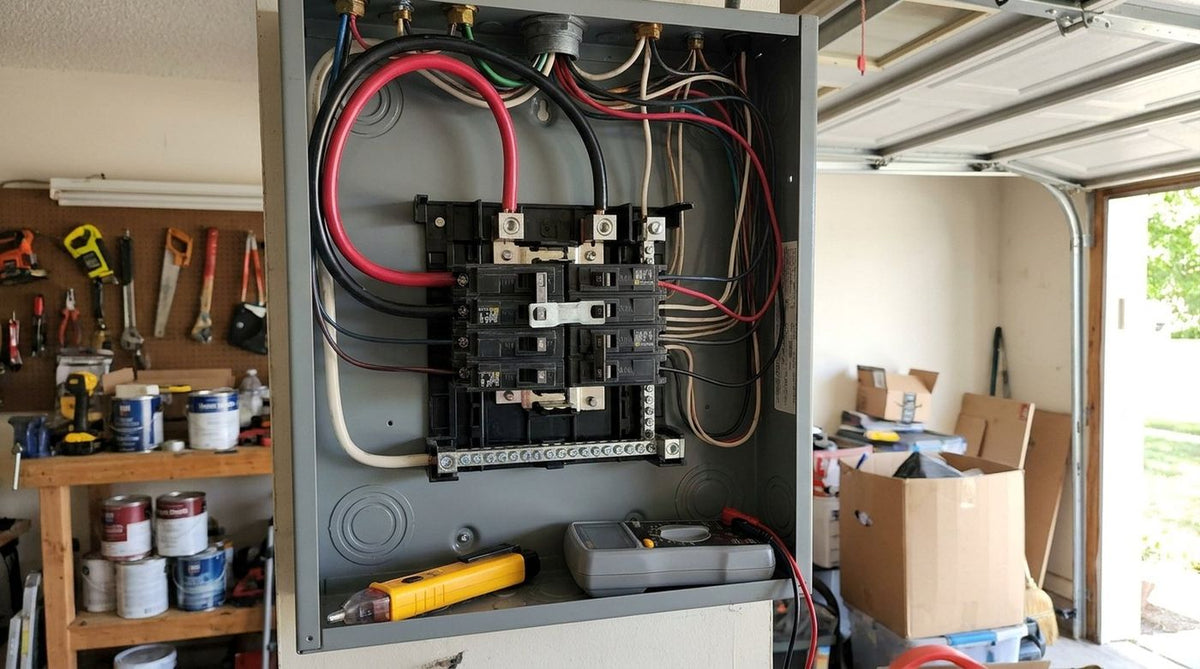
A multiwire branch circuit is one of the few genuinely elegant things in residential wiring. Two ungrounded conductors from opposite legs, one shared grounded conductor, and because the two legs are 180 degrees apart the neutral carries only the difference between the two loads rather than their sum. You get two circuits on three conductors instead of four. Less copper, less conduit fill, less heat.
It is also the configuration that produces the most confident wrong assumptions in the trade, and a meaningful number of them are fatal.
Everything depends on the two hots being on opposite legs
Start with the failure that has nothing to do with people getting hurt and everything to do with houses burning. If both ungrounded conductors land on the same bus leg, the currents no longer cancel on the neutral. They add. Two circuits pulling sixteen amps each now put thirty-two amps on a 12 AWG neutral that has no overcurrent device of its own, because a grounded conductor is not individually protected.
Nothing trips. The two breakers each see sixteen amps and are perfectly content. The neutral heats up inside the wall for as long as those loads run together. This is the single most common way a shared neutral is installed wrong, and it is almost always a panel-side mistake made by somebody who did not know the two hots had to be separated.
The same arithmetic explains why a handle tie and a two-pole breaker are not interchangeable in every context but both satisfy the requirement in 210.4(B) that all ungrounded conductors of the circuit disconnect simultaneously. Simultaneous disconnect is the point. Not convenience.
What happens when the neutral opens
Here is the part that most apprentices are never walked through, and it is worth drawing on a scrap of drywall for anybody who has not seen it.
With the neutral intact, each load sits between its own hot and the neutral, at 120 volts. Open that neutral and the two loads are suddenly in series across 240 volts, with the former neutral point floating between them. Where it floats depends entirely on the relative impedance of the two loads. Put a 1500 watt space heater on one leg and a single LED lamp on the other, and almost the entire 240 volts appears across the lamp. It does not dim. It fails, along with anything else plugged into that side.
Homeowners describe this as half the house acting strange. Electricians who have chased it describe it as the call where a customer lost a refrigerator, a television and a furnace board in the same afternoon.
Now the version that hurts people. That shared neutral is a current-carrying conductor for both circuits. Turn off one breaker and the neutral is still carrying the return current of the other one. Open it — unscrew the wire nut, pull it off a receptacle terminal, cut it to extend a circuit — and you have just inserted yourself in series with an energized load. You are not touching a hot. You are completing the return path of one, and 120 volts will push current through you to whatever else you are touching.
The white conductor in a multiwire branch circuit is not a neutral in the sense most people mean. It is a shared return path that can be fully energized while the breaker you turned off is still in the off position.
This is why 300.13(B) requires that the continuity of the grounded conductor not depend on the device. The neutrals get spliced and pigtailed to the receptacle. Pull the device out for replacement and the shared neutral downstream stays connected. Rely on the device's terminals to carry the splice through and every future receptacle change becomes an opportunity to open a live neutral on somebody.
Why the handle tie exists
The lock-and-test habit most of us were trained on is: kill the breaker, test the conductor, work. On a multiwire branch circuit that procedure is not sufficient, because the conductor you did not test is still hot and the neutral you never think to test is still working.
Requiring simultaneous disconnect closes that gap. You cannot turn off one half of an MWBC without turning off the other, and with both ungrounded conductors open there is no load current left for the shared neutral to carry. That is the whole mechanism. In the 2008 code cycle the simultaneous disconnect requirement was extended to all multiwire branch circuits rather than only to those supplying devices on the same yoke, and 210.4(D) added grouping and identification at the point of origin so the next person can see what he is looking at.
The failure mode this addresses is not hypothetical. NIOSH's Fatality Assessment and Control Evaluation program has published narrative investigations of occupational electrocutions for decades, each with a cause analysis and prevention recommendations, and its monograph Worker Deaths by Electrocution analyzes 224 incidents and the failures of assumption behind them. Reading a handful of those reports does more for a crew's habits than another toolbox talk about lockout.
The numbers have not gone away. The Bureau of Labor Statistics recorded 142 fatal injuries from exposure to electricity in 2024, up from 130 in 2023. ESFI's analysis of 2011 through 2024 attributes 20 percent of workplace electrical fatalities to unexpected contact with an energized source, with the electrician fatality rate at 2.89 per 100,000 workers against 0.11 for all occupations.
Working on one in practice
A short list of habits that separate people who are comfortable with shared neutrals from people who should not touch them:
- Verify the two hots are on opposite legs at the panel with a meter, not by counting spaces. Tandem breakers and a re-arranged panel will lie to you.
- Test the neutral before you open it, referenced to ground, and test it again with a load on the other leg if you can.
- Pigtail every neutral splice. No device in the continuity path.
- Treat an AFCI or GFCI requirement on an MWBC as a two-pole device problem from the start, not something to solve at trim.
- Label it. The next person in that panel will not be you.
Article 210.4 and 300.13 are short. They are available through NFPA's free access portal, which requires a free account. The reasoning behind them takes longer to absorb than the text does to read, which is fairly typical.
If the shared-neutral case is one you have wired correctly for years without being shown the current paths, our NEC Bonding and Grounding Requirements guide traces them out in drawings, including what the grounded conductor is doing when you assume it is doing nothing.