
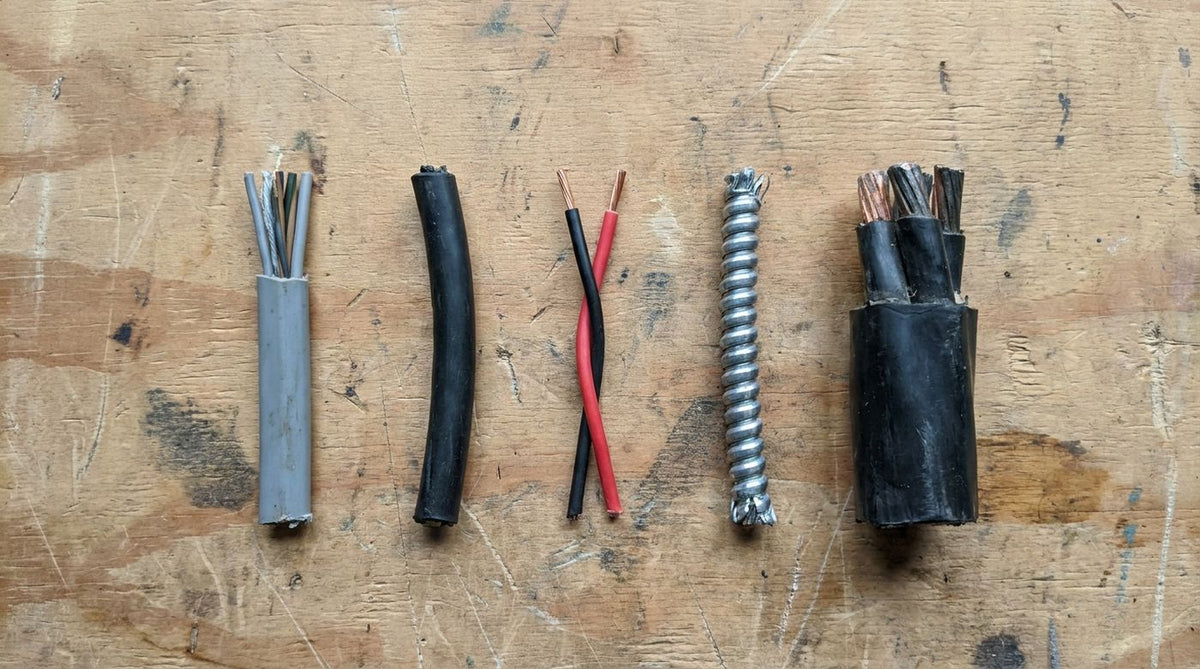
Cable type is the part of the trade where the wrong answer looks fine. A circuit wired in the wrong cable works. It reads correct on a meter, it passes a continuity check, it turns the light on. The failure is deferred, sometimes by years, and when it arrives it arrives as water in a jacket, a corroded conductor or a cable that was never rated for the mechanical abuse it has been taking. This is why inspectors are unmoved by the argument that it functions.
NM, and the two words that matter
Nonmetallic-sheathed cable — Romex to everybody, though that is a brand — is covered in Article 334. It is a dry-location, indoor, concealed-or-exposed wiring method for dwellings and certain other structures, and the operative constraint is that it may not be used in wet or damp locations. Not in conduit underground, not in a crawlspace that takes water, not stapled along the outside of a foundation wall, not run through a slab.
The second constraint is the temperature one people forget: the conductors in NM-B are 90-degree rated, but the cable's ampacity is taken from the 60-degree column. That is not a terminal-rating question, it is written into the article. Starting a derating calculation from the 90-degree column for NM is legitimate; using a 90-degree value as the final answer is not.
UL's Fire Safety Research Institute tested six cord and cable types including 12-2 and 12-3 NM-B under flashover conditions and documented how each behaved and whether the breaker, GFCI or AFCI ahead of it responded. It is the most direct published evidence of what happens inside a jacket that has been pushed past its rating.
UF, which is not just outdoor NM
Underground feeder cable, Article 340, looks similar and is a different animal. The conductors are molded into a solid thermoplastic body rather than wrapped in a paper-separated assembly, which is what makes it suitable for direct burial and wet locations and also what makes it miserable to strip.
UF is sunlight-resistant when marked, direct-burial rated, and permitted where NM is not. What it is not is a universal upgrade — it carries its own 60-degree ampacity limitation and it is not permitted as service-entrance cable, in commercial garages, in theaters, or embedded in poured concrete, among other places. Burial depth requirements come from Table 300.5, not from Article 340, and are one of the more commonly missed items on a rough inspection.
The NIOSH FACE program's investigation files include a case in which an HVAC contractor and his employee were both electrocuted in a North Carolina crawlspace. The FACE database is searchable by circumstance, and reading two or three of the narratives does more for a new apprentice's respect for damp-location rules than any amount of lecturing.
THHN and THWN, which are conductors and not cables
THHN is a building wire — a single conductor, not an assembly — and it belongs in a raceway. The letters decode: thermoplastic, heat-resistant, nylon-jacketed. Ninety degrees, dry locations only. THWN is thermoplastic, heat- and water-resistant: 75 degrees wet, and THWN-2 is 90 degrees wet as well as dry.
Almost everything sold in the United States now is dual-marked THHN/THWN-2, which is why the distinction feels academic on the truck and does not feel academic when someone pulls single-rated THHN into a conduit that runs underground or outdoors. Underground conduit is a wet location by definition, including the portion above grade. Read the print on the jacket rather than the label on the spool.
Two mechanical rules apply across all of them and account for a large share of rough-in corrections. Cables and raceways run through framing members need protection from screws and nails — a steel plate where the bore is less than an inch and a quarter from the edge of the stud — and cables need supporting and securing within a stated distance of every box and at intervals along the run. Neither is glamorous and both are checked on every inspection.
MC and SE, and the mistakes specific to each
Metal-clad cable, Article 330, is an assembly with an interlocked or corrugated metal armor. The critical detail is that standard MC contains a separate equipment grounding conductor and the armor alone is generally not an acceptable equipment grounding path — that is MC-AP or AC cable territory, and confusing them produces a ground path that measures fine and clears a fault badly. Older MC in a renovation may not match what you assume it is.
Service-entrance cable, Article 338, comes in SE and USE styles that are not interchangeable. USE is for underground service conductors and is not rated for interior use above ground. SE used as an interior branch circuit or feeder is permitted, but the conductor ampacity for that use has been restricted to the 60-degree column for several cycles now — the change that made a lot of existing 6/3 SE range and dryer feeds no longer sized the way people had been sizing them.
All of these article numbers can be read through NFPA free access with a free account, and it is worth reading the "uses permitted" and "uses not permitted" sections of each rather than relying on shop habit. OSHA takes the same view: its general industry electrical standard explicitly references the National Electrical Code as the source of its installation requirements, which means a wiring-method violation is not only a code problem.
The short version is that each of these cables was designed for a set of conditions and tested against them, and substituting one for another moves the installation outside the conditions it was listed for. That is the answer to "but it works."
Wiring methods and their permitted locations are set out side by side in Volume 1 of the Illustrated Guide to Understanding the National Electrical Code, which is a faster reference than flipping between five articles when you are standing in a supply house.