
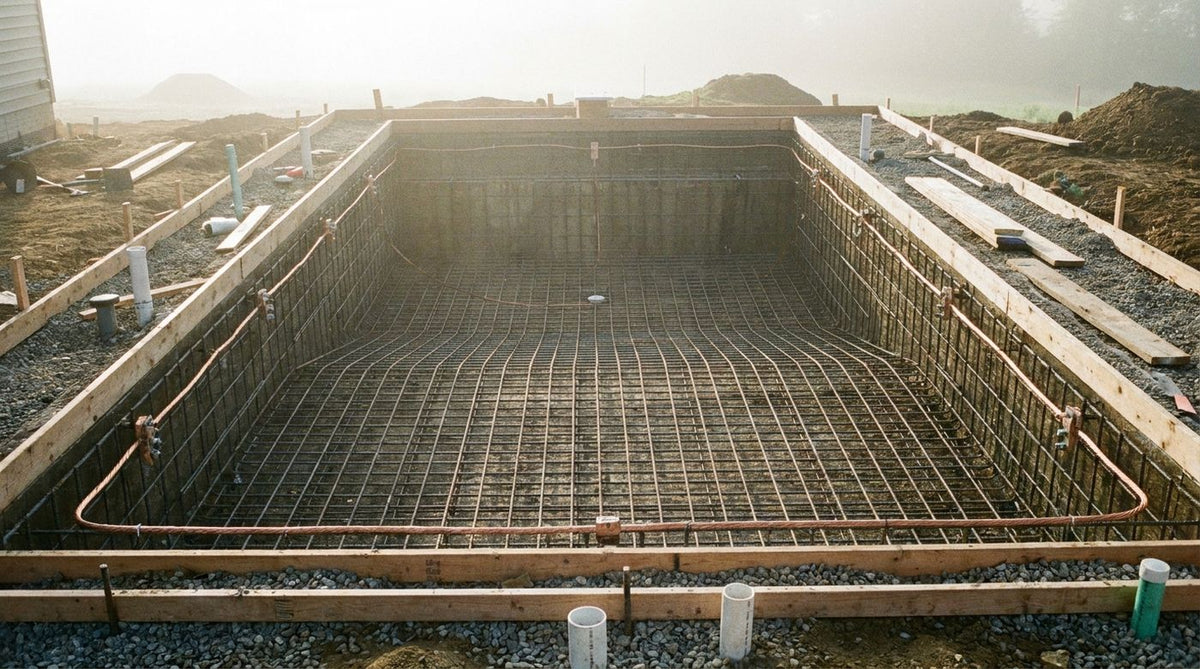
Article 680 is the part of the code with the least tolerance for a reasonable-sounding shortcut, and the reason is physical rather than regulatory. Everywhere else, the hazard is current through a person who touches something energized. Around water, the hazard is current through a person who touches nothing at all.
A body in a pool is wet, barefoot and in contact with a large conductive volume at more than one point. Skin resistance, which is most of what protects you in a dry environment, is gone. The body becomes a low-impedance path between whatever its hands are near and whatever its feet are near, and it does not take a fault to make that dangerous.
What a voltage gradient does to a person in water
Soil and water are not equipotential. Current flowing through them produces a voltage that varies with distance from the source, and the difference between two points a body spans is what drives current through the body. This is the same mechanism as step potential around a downed conductor, and it is why livestock are killed by it while standing in a field with no contact to anything electrical.
Around a pool the distances are short and the medium conducts well. A small leakage current from a pump motor, an underwater luminaire or a neighboring utility fault can put a few volts across the length of a pool. A few volts is nothing on dry skin. In water, across a swimmer's body, it is enough to cause involuntary muscle contraction. The person cannot let go of the ladder, cannot swim, and drowns. Nothing burns, no breaker trips, and the finding is drowning. That is the case the bonding grid exists to prevent, and it is why the hazard is chronically underestimated: the evidence disappears.
CPSC tracks the category in its report on Electrocutions Associated With Consumer Products, 2011 to 2020, and NIOSH's monograph Worker Deaths by Electrocution compiles 224 investigated incidents with the mechanism analysis attached to each one.
The grid is not there to trip anything
This is the sentence that fixes most people's understanding. Equipotential bonding is not grounding. It has no role in clearing a fault, it is not a fault return path, and it is not sized for fault current. Section 680.26 says so by what it requires: a solid copper conductor, not smaller than 8 AWG, tying the shell, the perimeter surface, the metal components, the equipment and the water together into one electrically common mass.
The point is to make the pool, the deck, the ladder, the handrails, the water and the person standing in them all sit at the same potential. If everything is at the same voltage, there is no difference across the body, and no current flows through it regardless of what that voltage happens to be relative to remote earth. The grid does not remove the voltage. It removes the gradient.
Grounding is still required, separately and for its own reasons. Equipment grounding conductors run to the pump, the luminaires, the panel and everything else metallic and electrical, and they do the ordinary job of carrying fault current back so a device opens. GFCI protection sits on top of that and catches the leakage a breaker never will. None of it makes the water safe on its own, because none of it addresses a gradient produced by a source you do not control, such as a neutral problem on the utility side of the meter. The grid does. That is the division of labor, and confusing the two is how a pool ends up with a beautifully grounded system and no equipotential plane at all.
Which is why bonding the perimeter surface out from the inside wall of the pool is not a technicality. The person standing on the deck reaching for the ladder spans the deck and the pool. If only one of them is in the grid, the grid has failed at exactly the place people stand.
- Solid copper, 8 AWG minimum, with connections listed for the purpose and for direct burial or encasement in concrete where that applies.
- The structural steel shell, the perimeter surface reinforcement or an alternative conductor grid, metal fittings, metal parts of electrical equipment, metal raceways and piping, and the water itself through an approved contact area.
- Double-insulated pump motors still require the bonding provision to be made available for a future replacement motor.
- The bonding conductor is not required to run to the panel, the service or any electrode. Running it there is a common, harmless-looking addition that changes what the system does.
Why inspectors are hardest on this
Most code violations erode a margin. A bonding grid violation removes a protection whose entire purpose is to catch a hazard that produces no symptoms until somebody dies. There is also no way to verify it after the fact without breaking concrete, which is why the inspection happens before the pour and why a missed inspection is genuinely unrecoverable.
On top of that, Article 680 layers requirements that are easy to satisfy separately and easy to get wrong together: GFCI protection for specified circuits and outlets, clearances for overhead conductors and for receptacles, permitted wiring methods for the pump circuit, disconnect location within sight, and separate rules for storable pools, spas, hot tubs and fountains, each in its own part. Any one of them is manageable. All of them on a job where the pool contractor has already poured is not.
CPSC has published its own position on the National Electrical Code as a voluntary standard, and the code text is available through NFPA's free access portal with a free account. Read 680 the week before the job, not the morning of.
Equipotential bonding is the clearest example of why bonding and grounding deserve their own study rather than a chapter inside general code work. The NEC bonding and grounding guide covers 680.26 with the grid drawn out and the perimeter case shown properly, and Volume 1 of the Illustrated Guide to Understanding the National Electrical Code takes the rest of Article 680 alongside it.