
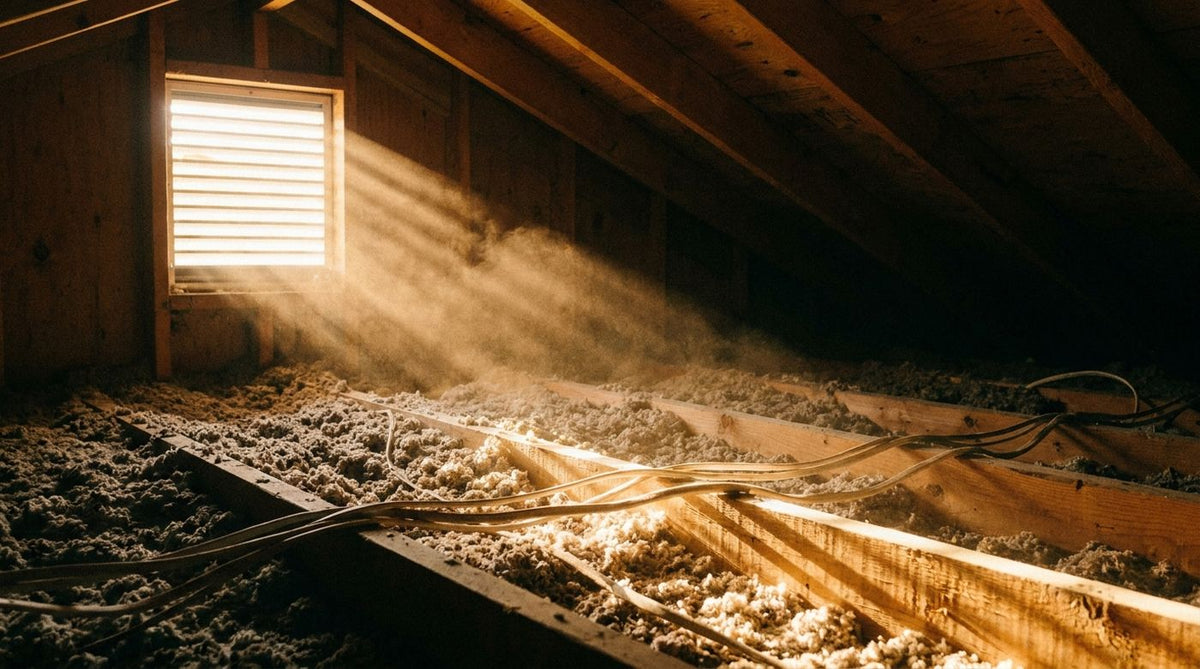
The same spool of 12 THHN behaves differently depending on where you put it. That sentence sounds like a trick, and it is the reason a lot of otherwise competent electricians lose points on calculations and occasionally lose an inspection. A conductor's ampacity is not a property of the conductor. It is a property of the conductor in a place, carrying heat away into whatever is around it.
Two things change the number. How hot the surrounding air is, and how many other conductors are making heat next to it. The code handles them separately, with a correction factor for ambient temperature and an adjustment factor for the number of current-carrying conductors, and the two stack.
The attic is a different circuit than the basement
Table 310.16 is built on an assumption of 30 degrees Celsius ambient — 86 Fahrenheit. That is a reasonable average for a conditioned space. It is nothing like an unvented attic in Phoenix in August, and it is nothing like a boiler room either.
When the ambient is higher than the table's basis, the correction factors in 310.15(B) knock the ampacity down. When it is lower, you are permitted to take it up. The attic case has an extra wrinkle: conductors run in a raceway or cable exposed to direct sunlight on or above a rooftop pick up substantial additional heat, and the code has carried temperature adders for that condition for several cycles. The exact treatment has shifted between editions, which is one more reason to know which edition your jurisdiction actually enforces — IAEI publishes a plain table of NEC adoption by state with effective dates, and the article text itself is available through NFPA free access with a free account.
The practical upshot is unglamorous. A homerun that leaves a cool basement panel, climbs into a 130-degree attic and crosses forty feet of open joist is not the same circuit at both ends, and the ampacity you are allowed to claim is the one for the worst portion of the run.
More than three, and the derate begins
The second factor is bundling. Once more than three current-carrying conductors share a raceway or cable, or are bundled together longer than 24 inches without maintained spacing, each of them loses the ability to shed heat to open air and the adjustment factors in 310.15(C) apply. Four to six conductors take one reduction, seven to nine take a larger one, and it keeps stepping down from there.
This is where the real question lives: what counts as current-carrying. The grounded conductor of a multiwire branch circuit that carries only the unbalanced current between the ungrounded conductors is generally not counted. The neutral of a three-wire circuit derived from a four-wire wye system is counted, because it carries roughly the same current as the phase conductors. The neutral on a circuit feeding substantial nonlinear load is counted, because harmonic current does not cancel the way the textbook says it should. Equipment grounding conductors are never counted.
That distinction is the single most commonly asked question in every apprenticeship code class in the country, and it is worth learning as a set of cases rather than a rule, because it genuinely is a set of cases.
Order of operations, and where it ends
Both factors multiply against the ampacity in the column matching the conductor's own insulation rating. You are permitted to start at 90 degrees for a 90-degree conductor even though you will never be allowed to terminate at that value. Apply the ambient correction, apply the conductor-count adjustment, and you have a corrected ampacity. Then compare that to the terminal temperature limit under 110.14(C) — usually the 75-degree column — and take the lower of the two. Then check the overcurrent device against the small-conductor limits in 240.4(D) if you are on 14, 12 or 10 AWG.
Three steps, always in that order, and the answer is whichever number is smallest at the end. Skipping the last comparison is the classic error. Starting from the 60-degree column and derating from there is the expensive error, and it is the one that makes a bid uncompetitive for no reason.
One exemption is worth knowing because it removes a lot of unnecessary derating: the adjustment factors generally do not apply to conductors in a nipple no longer than 24 inches, and there is a separate allowance for cables or raceways in an attic where only a short length is in the hot zone. Neither of those is a license to ignore the rule, but knowing they exist stops people from derating a whole feeder over an eighteen-inch section of pipe between two enclosures.
Nonmetallic-sheathed cable has its own trap here. The conductors inside NM-B are 90-degree rated and you are permitted to use the 90-degree column as the basis for the derating math, but Article 334 caps the cable's ampacity at the 60-degree column regardless of what the calculation produces. That is a third ceiling stacked on top of the other two, and it is the one people miss on residential work where NM is the default method.
What heat actually does to the cable
The reason any of this exists is that insulation is a consumable. It has a service life that shortens with temperature, and a conductor operated persistently above its rating does not announce itself. It ages quietly, gets brittle, and then one day a nick or a pinch that would have been harmless in year two becomes a fault in year fifteen.
UL's Fire Safety Research Institute ran energized cords and cables — including 12-2 and 12-3 NM-B — through flashover fire conditions and documented how those cables behave under thermal insult and whether the breaker, GFCI or AFCI ahead of them responds. It is the clearest published look at what is happening inside the jacket when the thermal assumptions in the table stop holding.
On the licensing side, this material sits squarely inside the paper people fail. Texas reported a 20.56 percent pass rate on the journeyman calculations exam in FY2025, against 24.46 percent on the NEC paper. Correction and adjustment factors are not the only reason, but they are one of the few topics where a candidate can know the concept, apply the multipliers in the wrong order, and land on a distractor that was written specifically for that mistake.
If the three-step sequence is something you have been reconstructing from memory on every job, the worked derating examples in the 2026 journeyman exam prep study guide are set out in the order you would actually use them.