
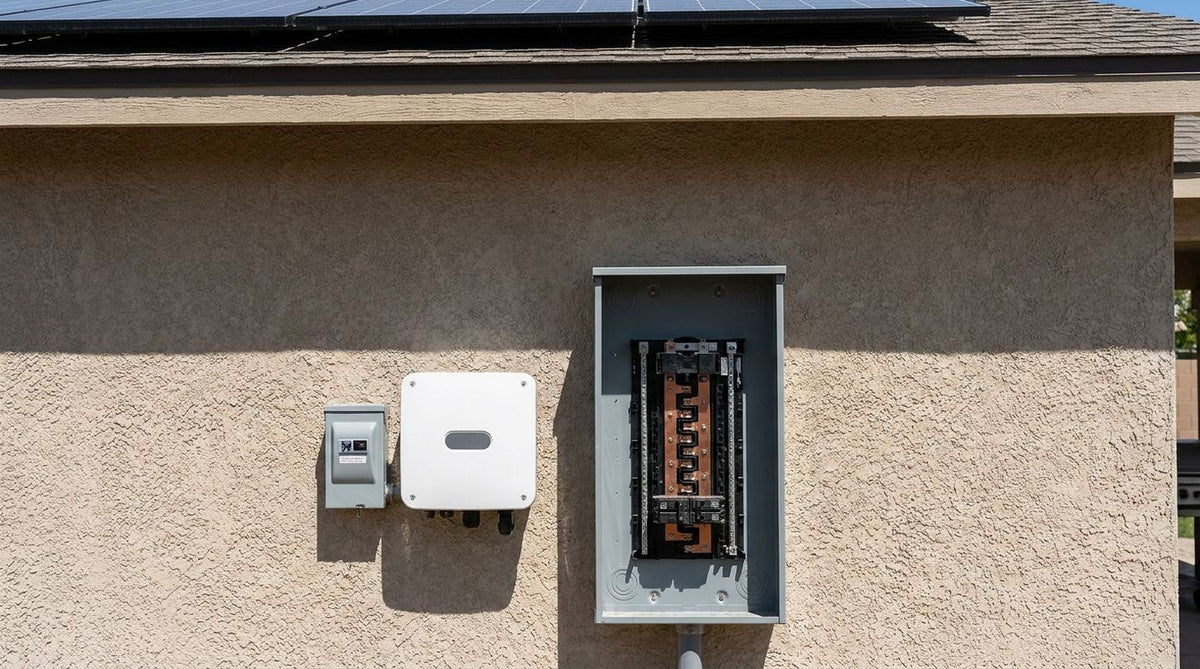
An eight kilowatt array lands on a house with a 125-amp panel and a 100-amp main. The inverter output is a 40-amp two-pole breaker. Everything fits in the panel, every conductor is sized right, and the installation may still not be legal, because the busbar is the thing being protected and nobody protected it.
Interconnection is the part of solar work that residential electricians get handed late, usually after a sales contract has already promised a system size. The two legal ways in behave very differently, and knowing which one you are doing before you quote saves an enormous amount of grief.
Supply side against load side
A supply-side connection taps the service conductors ahead of the service disconnect, under the allowance in Article 230 for more than one set of conductors tapping a service, with the PV system getting its own disconnect and overcurrent protection. Electrically it is a second service-like tap. Nothing the array does passes through the existing panel's busbar, so the panel's rating is irrelevant to the array. That is why supply-side is the default answer for a big system on a small service.
The costs are real. You are working on unfused service conductors, which means a utility disconnect or a hot tap, the meter has to come off, and plenty of jurisdictions and utilities have their own paperwork for it. Some AHJs simply do not like them. But the busbar calculation goes away.
A load-side connection puts the inverter output onto the existing panel through a breaker, and now the busbar has two sources feeding it from two ends. That is the situation Article 705 is written around, and it is where the 120 percent allowance lives.
What the busbar actually experiences
A busbar in a normal panel is fed from one end. Current enters at the main and leaves through the branch breakers, so the bar carries its maximum at the main end and progressively less further down. The main breaker sees everything the bar carries, which is why a 200-amp main protects a 200-amp bar.
Add an inverter at the far end and the picture changes. Utility current enters at the main, inverter current enters at the other end, and they meet somewhere in the middle. Neither device sees the total. The main sees only the utility portion. The inverter breaker sees only the inverter portion. The bar between them can carry more than either device is measuring, and neither one will ever trip on it.
The 120 percent allowance in 705.12 is the arithmetic that keeps that from mattering. In its common form, the sum of the rating of the overcurrent device protecting the busbar and the rating of the inverter breaker is permitted to reach 120 percent of the busbar rating, with the inverter breaker at the opposite end of the bar from the primary supply and a label saying so. The 20 percent margin is not generosity. It is a judgment about how much sustained overload a listed busbar tolerates given that the excess exists only in a limited section of bar and only while the array is producing.
Run it on the example above. A 125-amp bar at 120 percent is 150 amps. A 100-amp main plus a 40-amp inverter breaker is 140. That one passes, with the breaker at the far end and the label on. Put the same array on a 100-amp bar with a 100-amp main and it does not, and no amount of conductor upsizing fixes it, because the conductors were never the problem.
- The calculation uses device ratings, not measured or calculated load. A lightly loaded house does not earn you extra room.
- Position matters as much as arithmetic. Opposite end of the busbar from the primary supply, and the label is required, not optional.
- 705.12 offers other paths too, including a sum-of-all-breakers approach and a feed-through arrangement. Read the one you are relying on rather than quoting the 120 percent number at an inspector.
- Article 705 has been reorganized substantially between recent editions. Confirm which edition applies before you build the argument.
Why an oversized array on a small panel is a real hazard
The failure mode is not dramatic, and that is the problem. An overloaded busbar does not arc and does not trip. It runs warm, then hot, on sunny afternoons when the array is producing and the house is also running air conditioning. Bolted connections at the breaker stabs loosen through thermal cycling, resistance rises at the loose joint, and the joint gets hotter than the bar. Eventually a stab fails, usually into the breaker rather than the bar, and the panel becomes a fire with an ignition source nobody can point to afterward. The U.S. Fire Administration counted 23,700 residential fires from electrical malfunction in 2023, with 305 deaths, 800 injuries and $1.50 billion in loss, and across ten years the dollar loss is up 28 percent even after adjusting for inflation.
Which edition of Article 705 your inspector enforces is a live question, because PV changes more between cycles than almost anything else. IAEI keeps a readable table of NEC adoption by state with effective dates, and the code text is available through NFPA's free access portal with a free account.
Solar also shows up on licensing exams out of proportion to how it is taught. One candidate's summary was blunt: the practice set sold by the testing agency contained not a single solar question, and the exam had more than twenty. Volume 1 of the Illustrated Guide to Understanding the National Electrical Code draws the busbar cases so the two-source geometry is visible rather than algebraic, and the journeyman exam prep guide works the 705.12 arithmetic in the form the exam asks it.