
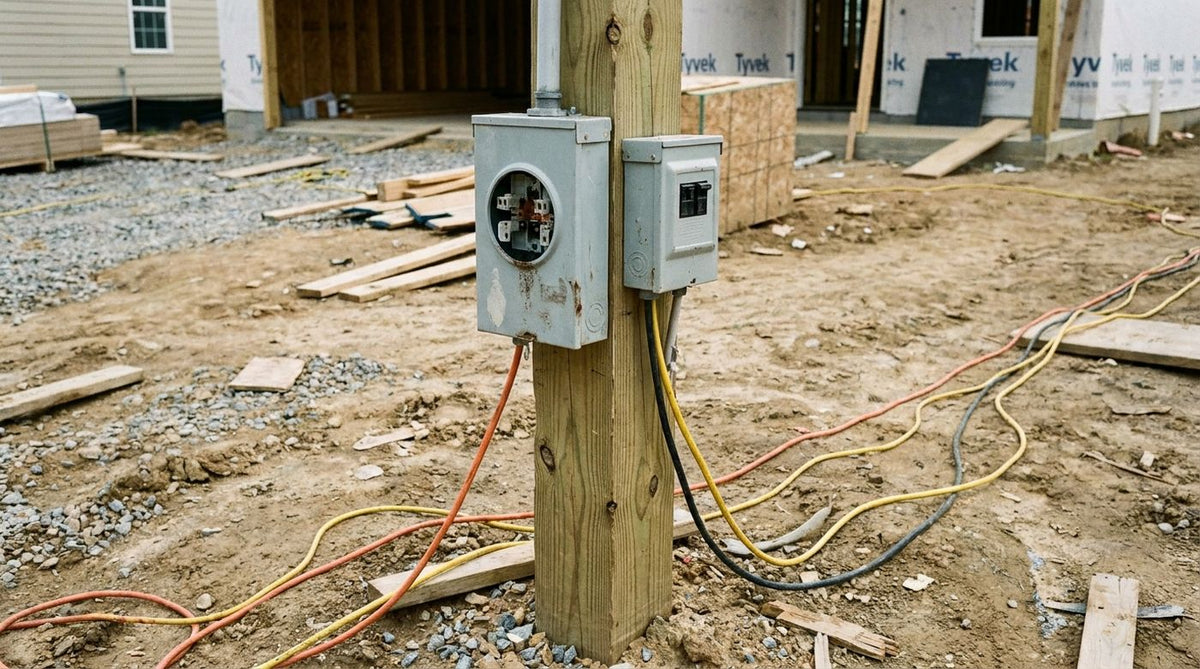
Temporary power is the part of a job that everybody treats as disposable and nobody treats as an installation. It goes in before the permit drawings are final, it gets modified by every trade on the site, and it comes out before anyone with authority has looked closely at it. The AHJ will inspect the temp service where it connects to the utility and then, in most jurisdictions, essentially stop caring. Which is exactly why the part that kills people is downstream of where the inspection ended.
OSHA does not stop caring. 29 CFR 1926 Subpart K is the construction electrical standard, it is enforceable on every site in the country, and it applies to the extension cord in a laborer's hand as much as to the panel on the pole.
Two ways to comply, and one of them is real
Subpart K gives an employer two options for protecting people using temporary receptacle outlets on construction sites. Ground-fault circuit interrupter protection for personnel, or a written assured equipment grounding conductor program. They are presented as alternatives. In practice, one of them gets used and the other gets claimed.
GFCI protection is the straightforward route: all 125 volt, single-phase, 15, 20 and 30 amp receptacle outlets that are not part of the permanent wiring of the building get GFCI protection for anyone using them. Either the receptacles are GFCI, or they are fed through a GFCI device, or you use listed cord sets with integral protection. That is the whole requirement, and it is why the spider box with GFCI receptacles across the face became the standard article on every site.
The assured equipment grounding conductor program is the other route, and the reason it is rarely done properly is that it is an actual program, not a decision. It has to be written. It has to be at the job site and available. A competent person has to be designated to implement it. Every cord set, every receptacle that is not part of the permanent wiring, and every piece of cord-and-plug-connected equipment required to be grounded has to be tested for continuity of the equipment grounding conductor, and tested again for correct attachment of that conductor to its terminals. Those tests happen before first use, before use after any repair, before use after suspected damage, and at intervals not exceeding three months. The results are recorded and the record is available.
The colored tape convention everyone recognizes — a different color each quarter — is a practical way to show the testing happened. It is not the requirement. Tape with no written program, no competent person and no records behind it is decoration, and an OSHA compliance officer will ask for the records, not the tape.
If the program is not written down and somebody's name is not on it, you do not have a program. You have colored tape.
Why OSHA cares more than the local inspector
The split is structural rather than philosophical. The AHJ enforces the adopted building and electrical code against an installation, and the NEC's temporary installations article is a short one in Chapter 5 covering how the temporary system is built and how long it may stay. The inspector's mandate largely ends with the installation. OSHA's mandate is the employee, on the day, using the equipment. A cord that was fine at rough-in and has since been run over by a scissor lift is squarely OSHA's problem and not really the inspector's.
The numbers argue for treating it that way. BLS counted 142 fatal injuries from exposure to electricity in 2024, up from 130 in 2023. And the dominant mechanism on a construction site is not the receptacle at all — ESFI's analysis of workplace electrical fatalities from 2011 to 2024 attributes 49 percent to contact with overhead power lines and 20 percent to unexpected contact. Temp power puts poles, masts, ladders, scaffold and boom equipment into the same airspace as the service drop. The temp pole location decision, made in about four minutes on day one, is one of the higher-consequence decisions on the whole job.
What goes wrong in practice
The failures repeat across sites and trades.
- Daisy-chained cord sets. Voltage drop is the visible symptom. The hidden one is a chain of connections, each of which is a place the equipment grounding conductor can open without anything looking different from the outside.
- Damaged cord jackets and missing strain relief. Cord that has been repaired with tape is not repaired. Subpart K expects the grounding conductor's continuity to be verified, which is precisely the thing a taped splice hides.
- Removed grounding pins. Still happens. Usually because somebody needed to plug a three-prong tool into a two-prong extension.
- Temp lighting hung by its conductors and strung through metal studs with no protection, which is a shock hazard the moment the jacket abrades.
- Generators wired wrong. Portable and vehicle-mounted generators are a different grounding case from a temp service fed from the utility, and treating them identically produces either a useless ground rod or a system where GFCI protection does not function as expected.
- Temp becoming permanent. The temporary installation article contemplates a limited duration. A temp panel that has been feeding a trailer for three years is not a temporary installation any more, whatever the label says.
Making it somebody's job
The single practical change that fixes most of this is assigning it. Temp power on most sites belongs to nobody after week one — the electrical contractor installed it, the GC owns the site, and every subcontractor modifies it. Write into the contract who inspects the temp system, how often, and who is authorized to red-tag a cord and remove it from service. That costs nothing and it is the difference between a program and an intention.
If you want to understand what these rules are actually preventing rather than just what they require, the case narratives are available. The NIOSH FACE database holds individual fatality investigations written by CDC investigators, each with a cause analysis and prevention recommendations. Reading three of them takes twenty minutes and changes how a crew talks about cord sets.
Temporary installations sit in Chapter 5 alongside the other special occupancy and special condition articles, and it is material most journeymen skim because it feels like it does not apply to them. Our Illustrated Guide to the NEC, Volume 2 covers Articles 500 through 760, including the temporary installation requirements, with the arrangements drawn rather than described.