
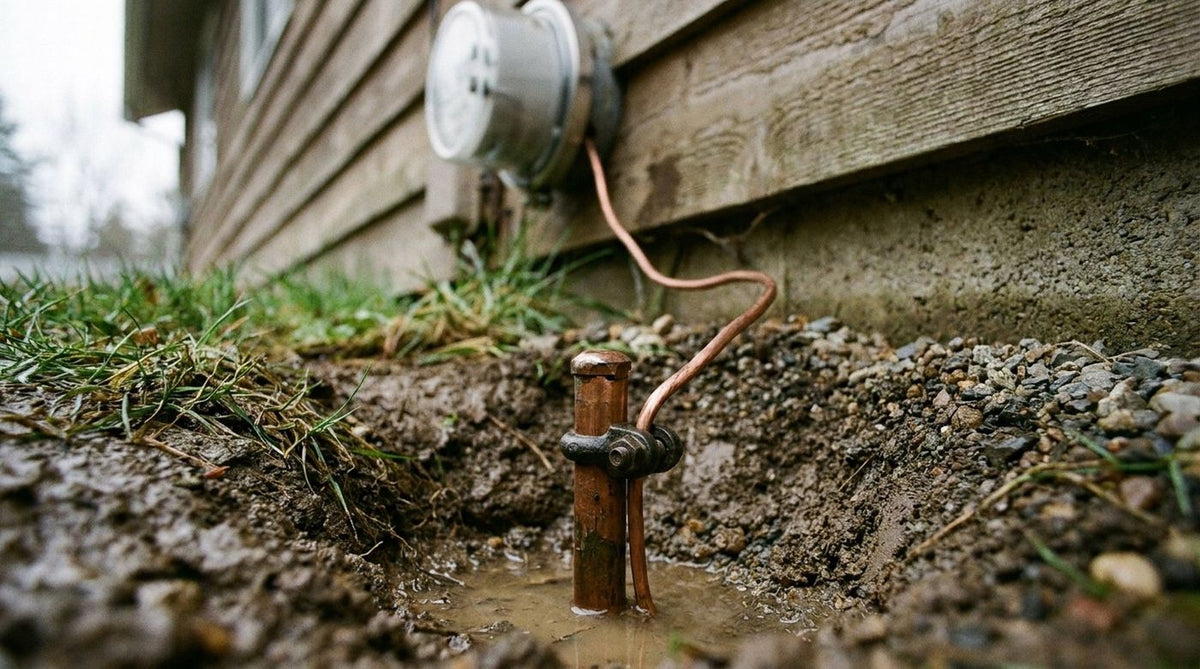
The single most common misunderstanding in this trade, held by homeowners, by plenty of apprentices and by more licensed people than will admit it, is that the ground rod clears faults. It does not. If you drive a rod, bond a live conductor to it and wait for the breaker to open, you will wait a long time and somebody may get hurt while you do.
Earth is a lousy conductor. A good rod in good soil might present twenty-five ohms. At 120 volts that gives you something under five amps — nowhere near enough to trip a 20-amp breaker, and more than enough to kill. Fault current goes home on the equipment grounding conductor and the neutral, through the main bonding jumper, back to the source. That is Article 250 Part IV and Part V doing the work, and it is a metallic path, not a dirt path.
So what is the electrode system for
Three jobs, none of which is clearing a branch-circuit fault.
- Reference to earth. It holds the grounded conductor and the enclosures near earth potential, so the voltage on the metal parts of a building stays where you expect it relative to the ground people are standing on.
- Lightning and surges. A strike or a surge needs somewhere to go that is not through the wiring and the occupants. This is the job the electrode system does best.
- Line-side events. Contact between a utility primary and a secondary, or a downed line, puts voltage on the system that no branch-circuit device is going to interrupt. The electrode system is part of what limits how bad that gets.
Understanding that split is what stops you from wiring a subpanel wrong. A ground rod at a detached structure does not replace the equipment grounding conductor in the feeder, and a rod does not license you to re-bond neutral and ground downstream of the service disconnect.
The menu in 250.52
The code does not ask for an electrode. It asks you to use everything present at the building, which is a different instruction and the source of most of the confusion.
Metal underground water pipe. Where a metal water pipe is in direct contact with earth for ten feet or more, it is an electrode and you have to use it. It also has a condition attached that no other electrode carries: it always needs a supplemental electrode, because the plumber who replaces a section with PVC next year has no idea he just removed part of your grounding system.
Concrete-encased electrode. The Ufer, named for the engineer who worked it out for ammunition bunkers in wartime Arizona. Rebar or bare copper encased in the concrete of a footing or foundation in contact with earth. It is the best electrode on the list by a wide margin because it is large, it is in permanently damp concrete, and concrete wicks moisture out of the surrounding soil. It is also the one you only get one chance at — once the pour is done, it is done. 250.50 requires it where it is present in new construction, and "present" has been the subject of a great deal of argument with inspectors.
Ground ring. Twenty feet of bare copper, not smaller than 2 AWG, buried around the structure. Uncommon in dwellings, standard on communications and utility sites.
Rod and pipe electrodes. Eight feet, driven, in contact with earth. The default because it is cheap and available, and the weakest of the practical options. 250.53(A)(2) is the rule that produces the two rods you see on most services: a single rod that does not test at twenty-five ohms or less needs a supplement, and since almost nobody owns a three-point fall-of-potential tester, almost everybody drives the second rod and moves on.
Plate electrodes and other listed electrodes round out the list, along with other local metal underground systems and structures.
Why several, bonded, beats one perfect one
Because earth contact is not a property you can inspect after the fact. Soil dries. Frost heaves. A rod in rock gets driven at an angle and stops short. The Ufer is entombed. The water pipe gets a plastic repair coupling. Every one of these electrodes can quietly stop working, and none of them announces it.
Bonding them together into one system means the failure of any single element degrades performance instead of eliminating it. It also means there is exactly one grounding reference in the building. Two isolated electrode systems on one structure — one at the service, one at a shed, not bonded — can sit at different potentials during a fault or a surge, and the difference appears across whatever is bridging them. Often that is a person, or a data cable, or a gas line.
This is the same logic behind bonding metal water piping, gas piping and structural steel under 250.104. Not because those are electrodes, but because anything conductive and reachable should be at the same potential as everything else conductive and reachable.
The goal is not a low resistance to earth. The goal is that everything a person can touch is at the same potential.
Where it goes wrong on real jobs
The failures repeat. Grounding electrode conductor spliced with a wire nut instead of an irreversible connection or a listed fitting. GEC run to a rod, then a second separate GEC run to the water pipe with nothing tying them together properly at the enclosure. Acorn clamps on a rod at the bottom of a hole nobody ever backfilled. Rebar cut flush at the slab edge and the Ufer abandoned because the framing crew got there first. A detached garage fed with three wires and a local rod, which was legal a long time ago and is not now.
None of these will fail an energization test. All of them will fail an inspection, and a couple of them will matter on the one night a year when something upstream goes wrong.
Worth remembering while you are down there: NIOSH's electrocution surveillance work, which publishes the full text of 224 investigative reports, is largely a record of current finding a path through a person because the intended path was missing or interrupted. The searchable FACE case database is free and worth an hour if you have never read one.
Article 250 rewards being read as a system rather than looked up as a set of answers. Our NEC Bonding and Grounding Requirements guide takes it in that order, and the code text is available through NFPA's free access portal with a free account.