
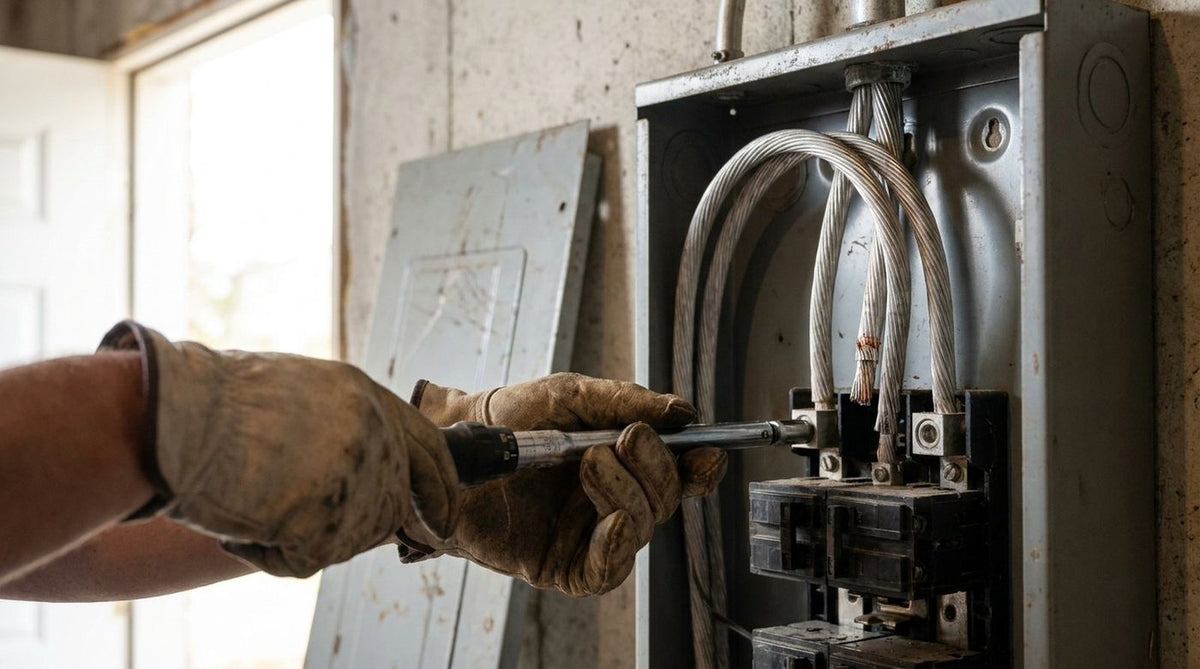
The torque screwdriver argument has been running on job sites since 110.14(D) got its teeth. One side says a good electrician's hand knows the right tension. The other side points out that the code now says where a manufacturer provides a torque value, the connection gets tightened to that value with a calibrated tool, and the hand is not a calibrated tool.
Both positions miss what the requirement is actually about, which is that a termination is not an electrical component. It is a mechanical joint that happens to carry current, and its electrical behavior is governed by mechanics.
Contact resistance is a pressure problem
Two pieces of metal pressed together do not touch across their apparent contact area. They touch at a scattering of microscopic high points. Current crowds through those points, and the resistance of the joint is set by how many of them there are and how large they are, which is set by the force squeezing the two surfaces together.
Under-tighten the lug and you have fewer, smaller contact points. Resistance goes up. Power dissipated at the joint goes up with the square of the current through it. The joint heats. Heat drives oxidation at the metal surfaces, oxide is a poorer conductor, so resistance climbs further and the joint heats more. That loop is why a marginal termination does not stay marginal. It degrades on a curve, quietly, for months or years.
Over-tighten and you fail the other way. You cold-flow the conductor, deform strands, crack the lug body or strip the threads. The immediate joint may read fine, but the metal is now stressed and it relaxes over thermal cycles. A connection that was over-torqued at installation can end up loose two winters later.
Aluminum makes both failures worse. Its oxide layer forms fast and is a good insulator, and it creeps under sustained pressure more than copper does, which means a joint tightened correctly today can relax on its own. That is why aluminum terminations have their own compound, their own listed connectors, and their own re-torque expectations.
Why a manufacturer's number became a code requirement
Article 110.3(B) has required for a long time that listed equipment be installed in accordance with its instructions. The problem was that the torque value printed on a lug label was widely treated as a suggestion. The 2017 cycle made it explicit: 110.14(D) brought a stated torque value into enforceable language and tied it to the use of a calibrated tool. The text is available through NFPA's free access portal, which needs a free account.
Two things follow that people miss. First, there is no requirement to invent a value where the manufacturer supplies none — the rule attaches to the value provided. Second, calibrated means what it sounds like. A torque screwdriver that has been in the bottom of a bucket for four years and never checked is not satisfying the intent, whatever it is satisfying on the inspection sheet.
Every termination you make is a small mechanical joint you will never look at again, in a place nobody will ever inspect, carrying current for thirty years.
What a bad connection does before it fails
A loose termination is one of the more efficient ignition sources available inside a building, for a reason that catches people out: it does not draw enough current to trip anything.
A high-resistance joint carrying a perfectly legal fifteen amps can dissipate tens of watts in a space the size of a fingernail. That produces a glowing connection, hot enough to char the insulation, the device body, the box and eventually the framing behind it. The breaker sees fifteen amps and does exactly what it was designed to do, which is nothing. This is why scorched receptacles turn up on circuits that never once tripped.
The common sites are predictable. Backstab connections, which rely on a small spring contact patch rather than a screw. Aluminum branch wiring at devices not rated for it. Neutral bar screws in a panel that were run down by hand. Lugs on a service disconnect that were never re-torqued after the conductors settled. Stranded conductors terminated under a screw with half the strands outside the plate.
In a panel the failure has a second act. A termination that finally lets go inside an enclosure can initiate an arcing fault, and an arc is not a modest event. OSHA's own material puts arc temperatures at around 35,000 degrees Fahrenheit and makes the point directly that low voltage is not low risk.
What the fire numbers say, and what to do about it
The national picture has not improved the way anyone hoped. The U.S. Fire Administration reports 23,700 residential fires caused by electrical malfunction in 2023, with 305 deaths, 800 injuries and $1.50 billion in loss. Across the ten years to 2023, the number of fires rose 2 percent and deaths fell 19 percent, while inflation-adjusted dollar loss rose 28 percent. NFPA's own home electrical fires report covers the same territory from the fire service side.
No dataset breaks out "loose lug" as a cause code, and it would be dishonest to claim one does. What the trade knows from opening burned panels is that a great many of those incidents began at a connection, and a connection is the one part of the installation entirely within our control and entirely unverifiable after the cover goes on.
Buy a torque screwdriver and a torque wrench for the larger stuff. Check them against a known reference occasionally. Read the label on the lug rather than reaching for a number from memory, because values vary by conductor size and by manufacturer in ways that are not intuitive. Re-torque service and feeder terminations after the conductors have carried load and settled, where the manufacturer's instructions call for it. And treat backstabs as something you undo when you find them rather than something you install.
It adds a few seconds per termination. That is the whole cost, and it is the cheapest risk reduction available in the trade.
If the general requirements in Article 110 are the part of the code you have absorbed by osmosis rather than by being taught, our Illustrated Guide to Understanding the National Electrical Code, Volume 1 takes them in order, with drawings of what a correct termination looks like next to what a failing one looks like.