
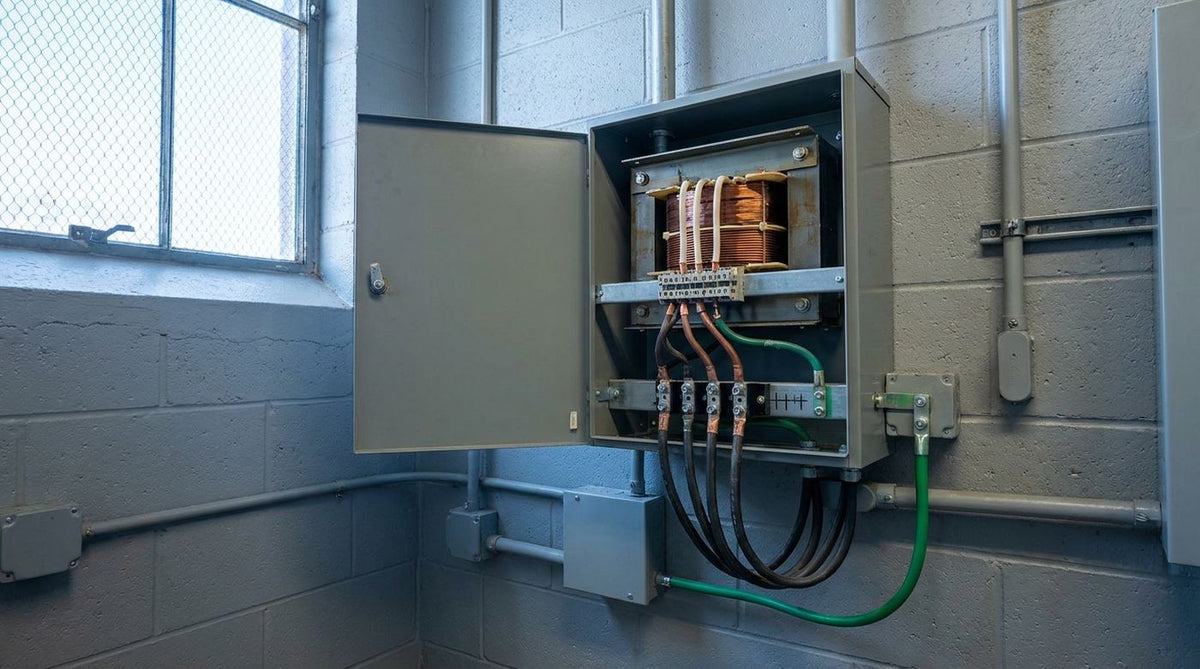
The quickest way to get a transformer wrong is to think of it as a piece of wire that changes voltage. Physically there is no copper path from primary to secondary. The two windings are coupled by a magnetic field in the core and nothing else, and that gap is the whole point. Whatever the primary system is referenced to stops at the core. The secondary arrives with no reference to earth at all until you give it one, and the moment you give it one you have created a new electrical system with its own service-like requirements.
That is what Article 250 means by a separately derived system, and it is why the same 120/240 volt panel behaves differently downstream of a transformer than downstream of a subfeed. In a subpanel, neutrals and grounds stay separated because the system bonding already happened back at the service. In a transformer secondary, the bonding has not happened yet. Wire that secondary panel the way you wire a subpanel out of habit and you have built a system with no fault return path and no way to trip anything.
The bonding jumper is the whole job
Section 250.30 is short, and almost every transformer failure an inspector writes up lives inside it. The system bonding jumper connects the secondary neutral point to the equipment grounding conductors and to the grounding electrode conductor, and it is installed at one place and one place only: either at the transformer or at the first disconnecting means, not both. Two bonds mean neutral current returns on the equipment grounding conductors and the raceway as well as on the neutral, and you will find it with a clamp meter reading current on a ground wire that should be carrying nothing.
The grounding electrode conductor then runs from that same point to a qualifying electrode, and the code is specific about which electrodes qualify and how close they have to be. A driven rod at the transformer while the building steel sits twenty feet away is the sort of thing that passes on a Friday and fails on a Monday. The point of the electrode is not fault clearing. Fault clearing is done by the bonding jumper and the equipment grounding conductors. The electrode is there for voltage reference and for the surge and lightning case.
The other half of 250.30 that gets skipped is the supply-side bonding jumper, which carries fault current from the secondary enclosure back to the bonded point. A raceway alone is sometimes permitted to do this and sometimes not, depending on the wiring method. This is one of the places where "it looks the same as the last one" is a poor argument.
Primary and secondary protection do not mirror each other
An electrician on r/electricians asked why you do not add 125 percent to primary and secondary conductors when the demand load is known, and the honest answer is that transformer protection is not a single rule but a set of permissions that trade off against one another. Article 450 protects the transformer. Article 240 protects the conductors. They are different objects with different failure modes and they get different devices.
Primary-only protection is permitted for many installations under Article 450, sized as a percentage of rated primary current, with the percentage depending on whether secondary protection is also provided and on the transformer's impedance and current rating. Where secondary protection is provided, the primary device is allowed to be larger. That is not a loophole. Transformer inrush is real: magnetizing current at energization can be many times rated current for a few cycles, and a primary device sized tightly to rated current will trip every time you close the switch.
Conductors are the separate question. Primary conductors are sized to the calculated load and protected in the normal way. Secondary conductors are the awkward ones, because the primary device generally cannot protect them at all. The turns ratio means a fault on the secondary appears on the primary as a much smaller current. That is why Article 240 contains specific tap and transformer secondary conductor rules with length limits and ampacity relationships, and why "I put a 60 on the primary so the secondary is covered" is wrong in a way that does not show up until there is a fault.
- A three-phase secondary is almost never protected by the primary device. Assume you need secondary protection unless you have worked through the rule and can point at it.
- Secondary conductor length limits are hard limits, not guidance. Ten feet and twenty-five feet mean what they say, and each comes with its own conditions.
- Where a transformer supplies a panelboard, the panelboard's own protection requirements still apply on top of everything above.
Why the AHJ is unforgiving here
Transformer installations combine three things inspectors have learned to distrust: a neutral point somebody has to bond correctly, an overcurrent scheme with several legal answers, and equipment that often gets installed by whoever was on site when it arrived. Which edition that inspector is working from matters too, because the separately derived system language has moved and been reorganized more than once. IAEI maintains a plain-text table of NEC adoption by state with effective dates, worth checking before you argue a section number with anyone. The code itself is available through NFPA's free access portal, which requires a free account.
The exam treats this the same way. Texas publishes its results, and in FY2025 the journeyman NEC paper passed 24.46 percent of candidates while the calculations paper passed 20.56 percent. Separately derived systems sit at the intersection of both: a grounding question wearing a calculation's clothes.
If bonding and grounding is the part that keeps catching you out, the NEC bonding and grounding guide covers 250.30 with the transformer cases drawn out, and Volume 1 of the Illustrated Guide to Understanding the National Electrical Code takes Article 450 alongside it so the protection and the bonding stop being two separate puzzles.