
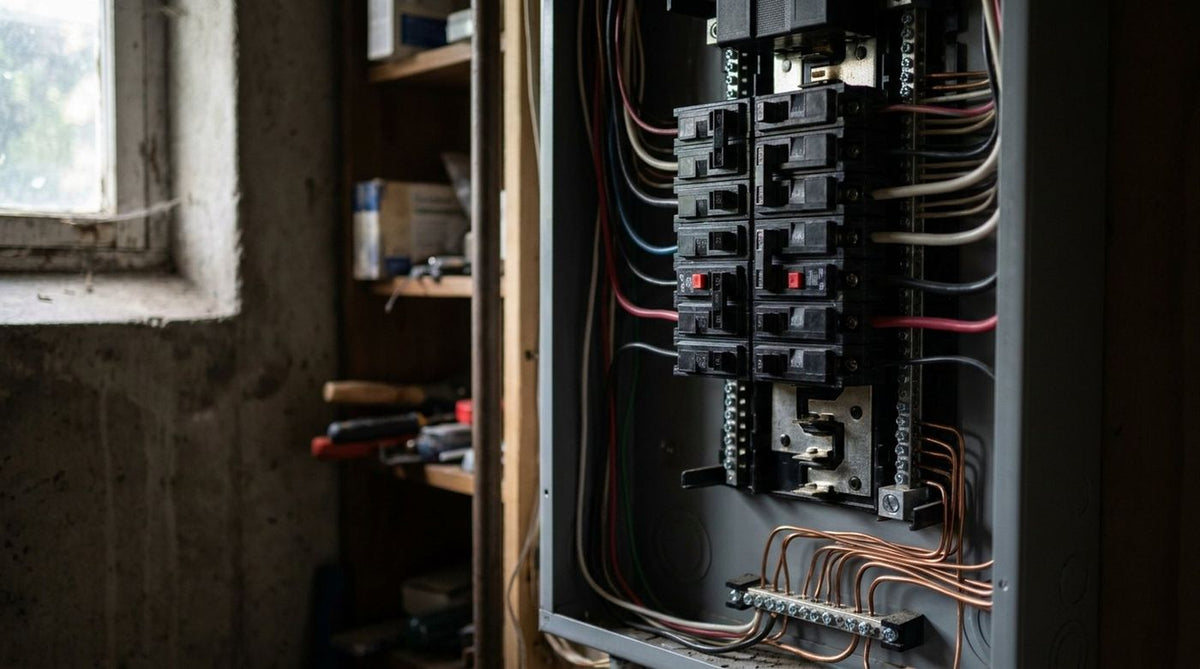
No device in residential work generates more open contempt than the arc fault breaker. Search any electrician forum and you will find the same sentence in a hundred variations: it trips and nobody can tell me why. The frustration is earned. The conclusion people draw from it — that the breaker is junk and the requirement is a manufacturer's racket — is worth examining, because the device is doing something more specific than most of us were ever told.
It is not looking for current. It is looking for a shape.
A thermal-magnetic breaker measures magnitude. Too much current for too long, or a lot of current instantly, and it opens. An arc is invisible to that. A loose backstab connection arcing across a gap draws whatever the load draws, which might be four amps on a fifteen amp breaker. It can burn for months at that level. It is a very effective ignition source and a completely legal current.
So an AFCI does not watch magnitude. It watches the current waveform for the fingerprint of an arc, and that fingerprint has a few recognizable features. An arc is not a resistor. It needs a minimum voltage to strike and it extinguishes near the zero crossing of the AC waveform, so the current goes flat for a moment each half cycle and then jumps back when the arc re-strikes. That produces a characteristic shoulder in the waveform, plus broadband high-frequency noise riding on top of the fundamental, plus a randomness from cycle to cycle that a normal load does not have. The electronics inside the breaker sample the current, run it through filters looking for that combination, and count how many cycles in a row it appears before deciding.
Combination-type devices look for two distinct cases. A parallel arc is hot to neutral or hot to ground and draws serious current, so it is detected at a relatively high threshold. A series arc is the broken conductor or loose terminal in line with the load, and it can only draw as much current as the load allows, so it is detected at a low threshold but requires the load to be drawing enough current for there to be a waveform to analyze at all. That second case is the one that matters for fires and the one that is hard.
The breaker is running pattern recognition on a noisy signal with about a hundred milliseconds to decide. Every false trip and every missed arc is a point on the same tradeoff curve.
Why shared neutrals and certain loads set it off
Most nuisance trips fall into a short list, and once you know the list the troubleshooting gets a lot faster.
- Shared neutrals. This is the big one. An AFCI breaker runs both the ungrounded conductor and the neutral through its sensing, and it also includes ground-fault protection of equipment at around 30 to 50 milliamps. On a multiwire branch circuit the return current splits between two breakers, so each one sees current out that does not match current back and interprets the imbalance as a fault. Feed a shared neutral through two single-pole AFCIs and it will trip, correctly, on the first load. You need a two-pole device, or you need to separate the neutrals.
- The neutral landed on the bar. Same failure, different cause. The circuit neutral has to land on the breaker's neutral terminal and the pigtail goes to the bar. Plenty of AFCIs that "arrived defective" were wired backwards.
- Brushed universal motors. Vacuums, treadmills, older power tools. The brushes are arcing continuously by design and the waveform looks a great deal like a series fault.
- Phase-cut dimmers and switching supplies. A triac chopping the waveform produces exactly the sharp discontinuities and high-frequency content the detector was built to notice. Cheap LED drivers are a recurring offender.
- Actual faults. This gets forgotten. A meaningful share of "nuisance" trips in older housing stock are real: a stapled cable pinched at a stud, a backstab that has relaxed, a nicked conductor in an overfilled box.
Before you swap the breaker, put the circuit on a known-clean load and see whether it holds. A breaker that holds a space heater for six hours and trips the moment the shop vac runs is telling you about the vacuum, not about itself.
What the fire data actually supports
This is where the honest version diverges from the marketing version. The original technical case for AFCI requirements rests substantially on a Consumer Product Safety Commission staff analysis of residential fire data, and that CPSC staff report is built on 1990s fire statistics. It is worth reading, and it is worth dating every time it is quoted. Housing stock, wiring methods, appliance populations and detection technology have all moved since then. Anyone who cites it as current evidence is not being careful.
What we do have that is current is the fire picture overall. The U.S. Fire Administration counted 23,700 residential fires from electrical malfunction in 2023, causing 305 deaths, 800 injuries and $1.50 billion in loss. Across the ten years to 2023, deaths from those fires fell 19 percent while inflation-adjusted dollar loss rose 28 percent. That is a real problem, and arcing is a real part of it, but the data does not isolate how much of the improvement any single device is responsible for.
The most useful recent work on what actually happens inside branch-circuit wiring during a fire comes from UL's Fire Safety Research Institute, which subjected six cord and cable types — including 12-2 and 12-3 NM-B — to flashover conditions and observed how arcing developed and how overcurrent, GFCI and AFCI protection responded. If you want to understand what an energized cable does when the room around it is already burning, that work is the best available.
Living with the requirement
Article 210.12 is not going away, and the scope has widened across cycles from bedroom circuits in the 1999 code to most habitable areas today. Which edition applies to you depends on your jurisdiction; NFPA's free access portal will show you the text with a free account.
The practical position is unsentimental. The device is imperfect, the evidence behind the original requirement is older than most of the people installing it, and the current fire numbers still justify caring about arcing connections. Treat a trip as information. Most of the time it is telling you about a shared neutral, a dimmer, a vacuum, or a termination somebody backstabbed in 1988.
If what you actually want is the reasoning underneath the requirement rather than a list of where it applies, that is the ground our Illustrated Guide to Understanding the National Electrical Code, Volume 1 covers, with the wiring cases that get reversed drawn out rather than described.