
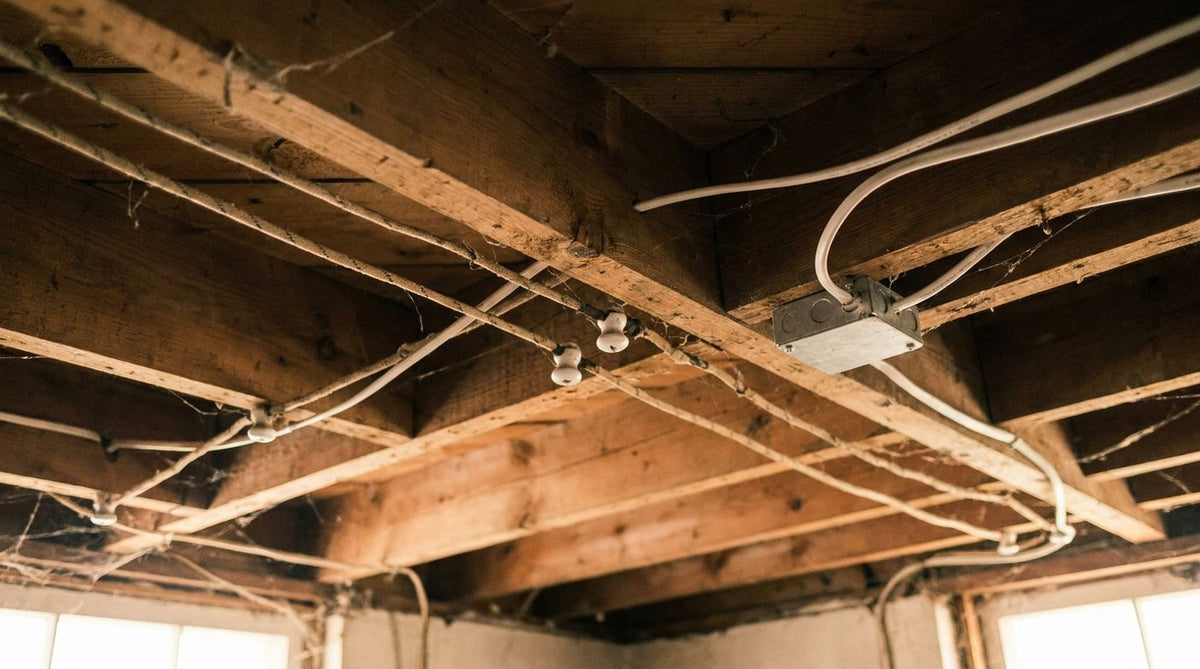
Service work in old housing stock is mostly an exercise in restraint. The customer wants a ceiling fan. You open the box and find cloth-covered conductors, no equipment grounding conductor, a splice that somebody soldered in 1948 and a neutral that has been doing several jobs at once. The question is not whether the house complies with the current code. It does not, and it never will. The question is narrower and more useful: what are you allowed to leave, and what will your work make worse.
The Code is a construction standard, not a maintenance standard
The NEC applies to new installations and to what you touch. An installation that was compliant when it went in is generally permitted to stay, and nothing obligates a homeowner to rewire a house because the rules changed. That is not a loophole; it is how the document is designed to work. Local property maintenance ordinances, insurance requirements and point-of-sale inspections can impose their own demands on top, and those vary wildly by jurisdiction. Which edition of the NEC you are actually being inspected against also varies — IAEI publishes a readable table of adoption by state with effective dates, which is worth checking before you argue a point with an inspector.
So the operating rule is simple to state and harder to apply: what you extend, alter or replace comes up to the adopted edition. What you leave alone stays. And you may not degrade what is there.
Knob and tube: leave it, do not feed it, do not bury it
Concealed knob-and-tube is covered by Article 394, and existing installations are permitted to remain. The conductors are usually fine where they are open in free air, which is exactly what the method was designed around — the air gap is the cooling and the insulation strategy at the same time. The failure modes are at the ends: brittle rubber where the conductors enter boxes and fixtures, soldered splices in free air with no box around them, and decades of somebody tapping into it.
The thing that turns an acceptable existing system into a genuine hazard is insulation. Article 394 prohibits concealed knob-and-tube in hollow spaces where loose, rolled or foamed-in insulation envelops the conductors. Every energy retrofit crew in the country has blown cellulose into an attic over live knob-and-tube without knowing what it was, and that is a real degradation of a system that was safe the week before. If you are the electrician on site and you see it, say so in writing. You did not create it, and you do not want to be the last licensed person who looked at it and said nothing.
When you do extend from it, the junction has to be in an accessible box. Twisting new NM onto a cloth conductor inside a wall cavity is the single most common thing found during demolition in these houses, and it is indefensible.
Aluminum branch circuits: a termination problem, not a conductor problem
Solid aluminum branch-circuit conductors on 15 and 20 amp circuits went into a large number of US houses between roughly the mid 1960s and the early 1970s. The conductor itself is not the issue. The issue is every place it lands on a screw: aluminum creeps under pressure, forms a resistive oxide layer, and expands and contracts at a different rate from the steel or brass it is clamped to. The connection loosens, heats, oxidizes further and heats more. It is a slow failure that ends at a device box.
The practical rules for working on it are about listings, and they are worth knowing precisely because half the advice you will hear on a job site is wrong.
- Receptacles and switches on solid aluminum branch circuits need to be marked CO/ALR. The CU-AL marking found on lugs and breakers is not the same thing and is not for solid aluminum branch conductors.
- Any connector joining aluminum to copper has to be listed for that combination and installed exactly as its instructions require, including any antioxidant compound. An ordinary twist-on connector is not listed for the job.
- Pigtailing to copper does not remove the aluminum from the circuit; it moves the connection into a box you have chosen. Whether that counts as a repair or a patch depends entirely on the connector used and how many terminations you actually addressed.
- Do not put a device on aluminum branch wiring that is not rated for it just because the existing one was not either. That is the "made it worse" line.
The CPSC has been publishing on residential electrical hazards for decades, and its page on the National Electrical Code is a reasonable starting point for the regulator's view of how product standards and the Code interact. Be careful with older CPSC material generally: the frequently quoted staff report on arc-fault protection, for example, rests on 1990s data and should always be cited with its date attached.
The two-prong replacement, done honestly
This is the everyday version of the problem. A grounding-type receptacle is being asked to go into a box with no equipment grounding conductor. Section 406.4(D) gives you three legitimate answers and one very common illegitimate one.
The legitimate answers: replace it with another non-grounding two-wire receptacle; install a GFCI non-grounding receptacle; or install a grounding-type receptacle downstream of GFCI protection. The last two require the outlet to be marked, and the markings are the honest part — the required wording tells the next person that there is ground-fault protection but no equipment ground. A GFCI will protect a person. It will not give a surge protector, a computer power supply or a piece of medical equipment the reference it expects. Marking it is not a formality, it is the disclosure.
The illegitimate answer is the bootleg ground: a jumper from the neutral terminal to the ground terminal. It makes a three-light tester read correct, which is the entire reason people do it. It also puts the metal parts of everything plugged in at neutral potential under load, and turns an open neutral into an energized chassis. There is no version of this that is defensible.
A tester that reads correct is not the goal. A tester that reads correct because of a jumper is worse than one that reads open ground.
The option nobody offers the customer is the good one. Section 250.130(C) allows an equipment grounding conductor for an extension or replacement to be run to several acceptable points — the grounding electrode system, the grounding electrode conductor, the service equipment enclosure or an equipment grounding terminal bar in the enclosure serving that circuit — rather than rewiring the whole branch circuit. In a house with an accessible basement or crawl space this is often an hour of work per circuit and it produces a real ground. It is worth quoting.
None of this is academic. Residential electrical malfunction fires in 2023 accounted for 23,700 fires, 305 deaths, 800 injuries and $1.50 billion in loss, and over the ten years to 2023 the dollar loss rose 28 percent even after adjusting for inflation while deaths fell 19 percent. Old wiring is a live part of that number, and the houses are not getting younger.
Most of what goes wrong in old work traces back to the grounding and bonding system — what is connected to what, and where the fault current is expected to go. Our guide to NEC bonding and grounding requirements works through Article 250 with the retrofit cases drawn out, including where you are permitted to land a retrofit equipment grounding conductor.