
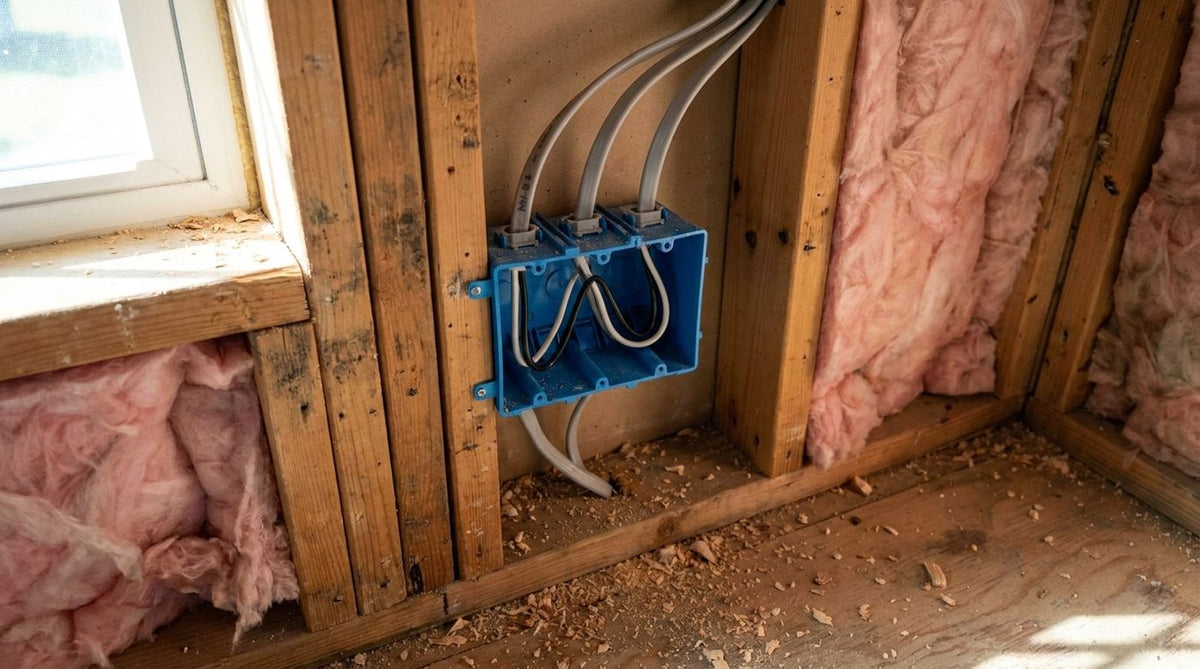
Ask around a crew why the box fill table reads the way it does and most of the answers come back to the same idea: it is about the wires fitting. That is the smaller half of the reason, and it is the half that lets a person talk himself into one more conductor because the cover still goes on flat.
Both fill calculations are really about two things the tape measure cannot see. One is heat. The other is what happens to insulation during the pull. Once you know that, the numbers stop looking arbitrary and start looking conservative, which is a different feeling entirely when an inspector is standing behind you.
A box is a small, still volume of hot air
Current in copper makes heat. Not much per foot, but a box is a sealed pocket of air with no meaningful airflow, usually buried in insulation, often with a device in it that is itself dissipating watts across its terminals and contacts. A dimmer is the obvious case. A plain receptacle carrying fifteen amps through two screw terminations is less obvious and still real.
Thermoplastic insulation does not fail at a cliff edge. It ages. Heat drives the plasticizer out of PVC over years, the jacket stiffens, and the first time somebody pulls the device forward to change it the insulation cracks at the bend and you have a conductor touching a grounded box. Every electrician who has opened a 1970s box packed to the gills has seen the brown, brittle version of this.
The volume allowances in Article 314.16 are sized so the conductors in that box can shed their heat into the enclosure and out through the wiring method without cooking themselves. That is also why the allowance scales with conductor size rather than being a flat count: a 12 AWG conductor has more copper, more current behind it and more surface to get rid of it, so it is given more cubic inches than a 14.
The same logic explains a rule that annoys people every year. NM-B is built with 90 degree C rated insulation, and 334.80 still makes you use the 60 degree C column for ampacity. The 90 degree rating is a starting point for derating, not a license to load the cable. The assembly, the terminations and the enclosures were never qualified at that temperature. You can read the article numbering yourself through NFPA's free access portal, which requires a free account to open the code text.
What the volume allowances are actually counting
The counting method trips people more often than the arithmetic does. A few things worth holding in your head, because they are where the corrections come from:
- Every conductor entering the box and terminating or splicing there counts once. A conductor that runs through without a splice also counts once. A pigtail that begins and ends inside the box counts for nothing.
- All equipment grounding conductors together count as one, no matter how many there are. An isolated ground gets one more.
- Internal cable clamps, all of them together, count as one. Fixture studs and hickeys get one each.
- A device on a yoke counts as two, based on the largest conductor connected to it. That doubling is the single most commonly missed line in the whole calculation.
Every allowance is based on the largest conductor in the group being counted, not on the conductor actually attached. Put one 12 into a box otherwise full of 14 and the device allowance goes up with it.
Conduit fill is about the pull, not the room
Chapter 9, Table 1 gives you 53 percent for one conductor, 31 percent for two, and 40 percent for three or more. People assume the numbers climb with quantity because more wires pack better. That is not it either.
The 40 percent figure is a pulling allowance. It leaves enough clearance that conductors can slide past one another and around bends without the sidewall pressure stripping insulation off the outside of the sweep. The damage does not announce itself. You get a nick on the outer conductor at a 90, the wire goes in, the circuit works, and three years later something gets bumped and there is a fault at a point nobody can see.
The 31 percent for exactly two conductors is the strange one, and it has a specific cause: jamming. Two round conductors in a round raceway can wedge side by side against the wall at a bend and lock. It is a geometry problem tied to the ratio of raceway inside diameter to conductor outside diameter, and it is worst in the range where three conductors nearly fill the circle. Derating the allowed fill for that case is cheaper than sending someone back to cut open a wall.
Heat comes back in on top of that. Once you have more than three current-carrying conductors in the same raceway, 310.15(C)(1) starts reducing ampacity, because each conductor is now surrounded by others that are also warm. Conduit fill and ampacity adjustment are the same physical concern approached from two directions.
Fill limits are not about whether it goes in. They are about whether it survives going in, and whether it can get rid of its own heat afterward.
Why people still get it wrong
Three reasons, in roughly the order they show up on a job.
The first is that a properly full box still looks fine. There is no feedback. The cover fits, the device sits flush, the inspector may not count, and the circuit works. Compare that to a bad bend, which is visible from across the room. Trades learn fastest from what shows.
The second is that the calculation is taught as a table lookup rather than as a reason. An apprentice who has been told the answer without the mechanism will apply it where he remembers it and skip it where he does not. The pain shows up later: Texas publishes its exam results every year, and in FY2025 the journeyman calculations paper had a 20.56 percent pass rate. Four out of five candidates who sat that section failed it.
The third is remodel work, where nobody is calculating anything. An existing box gets one more cable and the device gets pushed back harder. That is how a large share of residential fires begin their careers as small problems. The U.S. Fire Administration counted 23,700 residential fires from electrical malfunction in 2023, with 305 deaths and $1.50 billion in loss. Over the ten years to 2023 the number of fires moved 2 percent and the dollar loss climbed 28 percent in inflation-adjusted terms.
None of that is an argument for being precious about it. It is an argument for doing the count in your head before you make the hole, because the box you choose at rough-in is the box you are stuck with at trim.
If the mechanism behind the tables is the part that never got explained to you, that is the gap our Illustrated Guide to Understanding the National Electrical Code, Volume 1 was built for. It walks the fill calculations with drawings rather than paragraphs, which is closer to how most of us actually think about a box.