
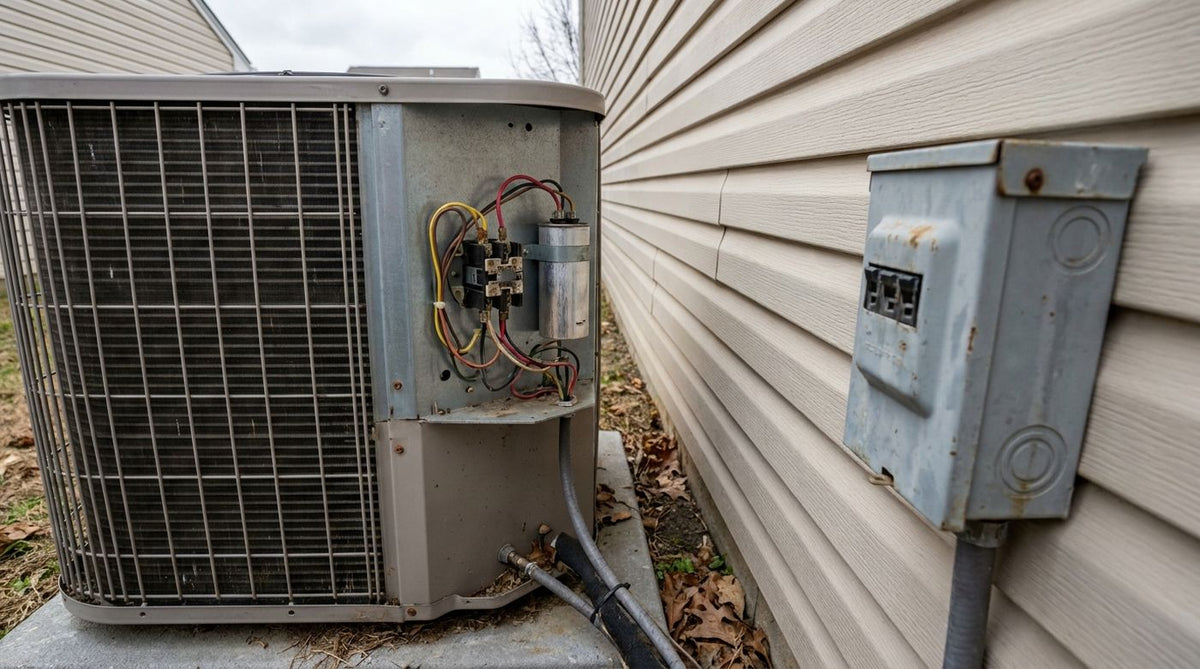
A condenser goes in on 12 AWG behind a 30-amp breaker, and the nameplate on the side of the unit says the thing draws less than half that. Somewhere in the back of your head a rule you have relied on for years starts complaining, because everything else in a house obeys one sentence: the breaker protects the wire. Article 430 does not work that way. It is not an industrial carve-out either. It applies to the air handler, the well pump, the pool pump and the garbage disposal exactly as it applies to a fifty horsepower chiller, and most residential electricians meet it sideways, on a service call, with nobody around to explain it.
The reason it looks wrong is that a motor circuit splits one job into two devices. Overload protection watches the motor over minutes and hours and takes it off line before the windings cook. Short-circuit and ground-fault protection watches the circuit for a bolted fault and clears it in milliseconds. A general-purpose branch circuit asks a single breaker to do both, and it can, because a lighting circuit never demands six times its running current on the way to doing its job. A motor does, every time it starts.
The nameplate amps are not the amps you size from
First thing that trips people up: for sizing conductors and most of the protective devices, the code sends you to its own full-load current tables rather than to the nameplate. The nameplate figure is used for the overload device. The table value is used for the conductors, the disconnect and the branch-circuit protection. They are usually close and occasionally not, and if you mix them you will get an answer that is defensible on the job and wrong on paper.
From there, a single motor on a branch circuit gets conductors sized at 125 percent of that table value, in Article 430 Part II. That is not the continuous-load 125 percent you know from Article 210 and it does not stack on top of it. It exists because a motor working hard sits near full load for a long time and because the starting current has to pass through the same copper. Feeders supplying several motors follow a different rule again, built on the largest motor plus the full load of the rest, which is why a shop feeder never looks like a dwelling feeder.
What a locked rotor actually does
An induction motor at speed is not just a coil of wire. The spinning rotor generates a voltage that opposes the applied voltage, and that opposition is most of what limits the current. At the instant you close the contactor, the rotor is not spinning. There is no opposing voltage. For that moment the motor is close to a short circuit through the winding impedance, and it will pull somewhere in the range of six to eight times its running current until the rotor comes up to speed. That is the inrush, and it is the whole reason the rules look strange.
Locked rotor is what happens when the rotor never comes up to speed. A seized bearing, a jammed impeller, a compressor that will not break loose on a hot afternoon, a single blown fuse on a three-phase feed leaving the motor single-phasing. The inrush current does not stop. It sits there, several times full load, dumping heat into windings designed to shed the heat of full-load current with the fan turning. Minutes matter. Insulation goes, and after that the motor is a ground fault waiting for somebody to reset the breaker.
So the branch-circuit device has to be large enough to let normal inrush pass without nuisance tripping, which is why Article 430 permits protective devices at percentages of full-load current that look absurd next to a receptacle circuit. And because a device that large cannot possibly protect the motor from a slow overheat, the overload device is required separately, sized from the nameplate, in the starter or built into the motor.
A journeyman writing up a failed master's retake put it plainly: "I wasn't totally surprised at the result, as I do sometimes struggle with neutral load calculations and some motor overprotection calculations."
Overload and overcurrent are not the same device
This is the distinction worth carrying around. Overcurrent protection is about fault current, and it lives in the panel. Overload protection is about heat over time, and it lives at the motor. Heaters, eutectic alloy elements, bimetallic strips, electronic overload relays and thermal protectors built into the motor all do the same job with different hardware, and they are all rated in trip classes describing how long they will tolerate a given multiple of full load before opening.
Practical consequences you will meet on a service call:
- A motor that trips its overload repeatedly is telling you something mechanical or electrical is wrong. Fitting a larger heater is not a repair, it is the last step before a fire.
- A motor that trips the breaker on start but never runs hot is usually an inrush problem, not an overload problem, and the fix is at the breaker end.
- A disconnect within sight of the motor is not a formality. Article 430 Part IX exists because somebody has to be able to kill that motor while standing next to it.
- Manufacturer overcurrent markings on listed equipment such as air conditioners override your calculation. The label on the condenser is the answer.
Why this eats so many exam candidates
Motor work is a small slice of residential hours and a large slice of the test. Texas publishes its numbers, and in FY2025 the journeyman calculations paper had a pass rate of 20.56 percent against 27.52 percent for the journeyman exam overall. Four out of five candidates failed the calculations section. Motors, with their two-device logic, their separate tables and their percentages that change depending on what you are sizing, are a reliable part of that damage.
The fix is not memorizing percentages. It is being able to say out loud, before you look anything up, which of the two jobs you are doing: protecting the conductor and the circuit from a fault, or protecting the motor from heat. Every number in Article 430 hangs off that fork. If you want to read the article itself, NFPA publishes the NEC through its free access portal, which requires a free account.
There are roughly 821,000 electricians working in the United States, and most of them will wire more motors than they expect to. Volume 1 of the Illustrated Guide to Understanding the National Electrical Code walks Article 430 with the drawings that make the two-device split obvious, and the journeyman exam prep guide drills the calculation sequence until the fork in the road is automatic.