
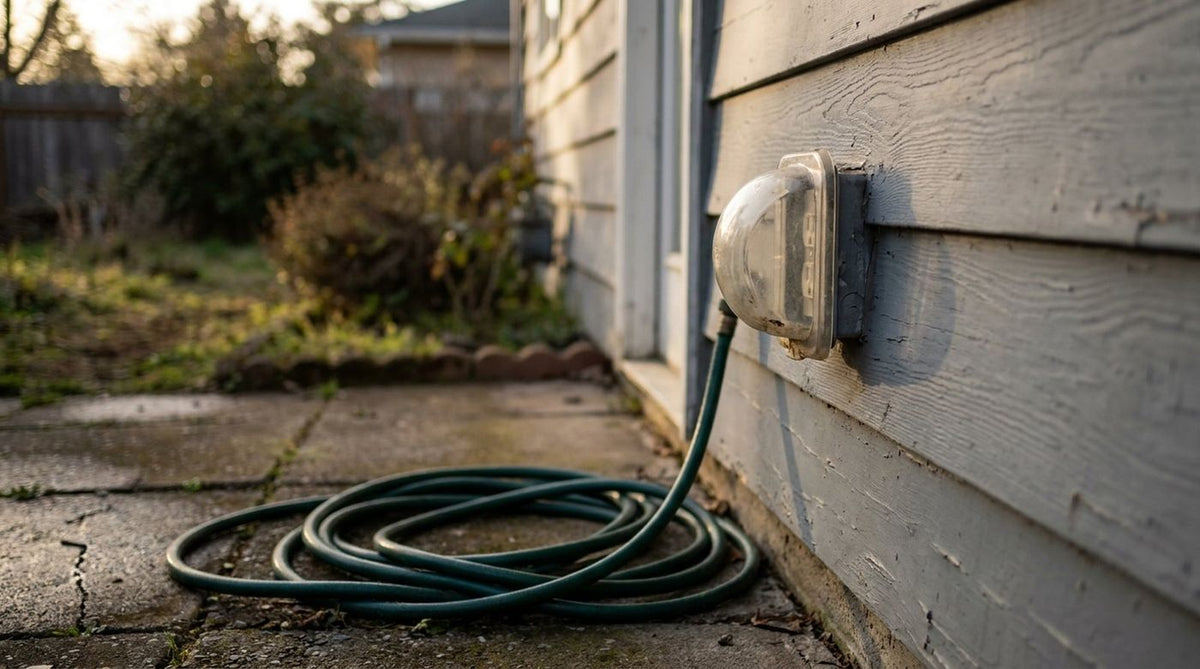
Every code cycle somebody on a crew says the same thing: they are going to require GFCI on everything eventually. That is closer to a description than a complaint. The list has grown steadily for fifty years, and the pattern of that growth is worth understanding, because it is not a committee getting carried away. It is a committee following bodies.
Five milliamps, and why that number
A GFCI does not protect the circuit. It protects the person. It compares current leaving on the ungrounded conductor with current returning on the grounded conductor, and if those do not match within a few milliamps, it opens in a fraction of a cycle. A Class A device is built to trip between four and six milliamps.
That threshold is set well below the current at which a person loses voluntary muscle control. Above roughly the let-go threshold, a hand gripping an energized part cannot open, and the contact continues until something else interrupts it. Somewhat higher currents across the chest can induce ventricular fibrillation. Five milliamps is chosen to be under the first of those, with margin, while still being high enough that the normal capacitive leakage of ordinary appliances does not cause constant tripping. Everything annoying about GFCIs follows from how narrow that gap is.
Note what this means about the equipment grounding conductor. A GFCI does not need one. It compares hot and neutral, so it still works on a two-wire circuit with no ground, which is exactly why replacing an ungrounded receptacle with a GFCI is permitted. It protects the person. It does not create a fault path, and the difference between those two ideas is where bootleg grounds come from.
Follow the list and you follow the injuries
The first requirements, in the early 1970s, were about swimming pools — underwater lighting and receptacles near the water. Then outdoor receptacles at dwellings. Then bathrooms. Then garages. By the late 1980s, kitchen countertop receptacles. Then unfinished basements and crawl spaces. Then wet bar sinks, then all kitchen counters, then laundry areas and dishwashers, then whole basements, and in recent cycles receptacles above 125 volts serving ranges and dryers.
Read that sequence again and notice what it is. It is a list of places where a grounded surface and a person meet: standing water, damp concrete, a sink, wet grass, a crawl space with bare earth. Each addition came after the previous scope proved insufficient — after the injury reports kept arriving from the next room over.
The narrative fatality investigations are where this becomes concrete rather than abstract. NIOSH's Fatality Assessment and Control Evaluation program publishes individual case reports with permanent identifiers, written by CDC investigators, each one with a cause analysis and prevention recommendations. Report 94-17, HVAC Contractor and Employee Electrocuted in Crawlspace, is the kind of document that explains a code requirement better than the code requirement does. Pair a rule with the case that produced it and the rule stops feeling arbitrary.
What the current numbers look like
The occupational picture is the part that should get a licensed person's attention, because the expansion of 210.8 is aimed at the public and the fatality rate among electricians is a separate, worse story.
- ESFI's analysis of 2011 through 2024 puts the electrical fatality rate for electricians at 2.89 per 100,000 workers, against 0.11 across all occupations — and records 5,180 non-fatal electrical injuries with days away from work in 2023 and 2024.
- The Bureau of Labor Statistics counted 142 fatal injuries from exposure to electricity in 2024, up from 130 the year before.
- On the consumer side, the Consumer Product Safety Commission's most recent analysis, Electrocutions Associated With Consumer Products 2011 to 2020, published in November 2023, tracks where product-related electrocutions are still happening in homes.
Those sources answer different questions and it is worth keeping them straight. ESFI and BLS describe people at work. CPSC describes people at home with a product in their hand. Article 210.8 is largely written for the second group, and the areas that keep getting added are the areas where that group keeps getting hurt.
Nothing in 210.8 was added because the situation looked risky. It was added because someone died in that specific room, doing that specific thing, and the report made it to the panel.
The complaints, honestly considered
Two objections come up constantly and they deserve different answers.
The first is nuisance tripping on appliance circuits — refrigerators, freezers, sump pumps. This one is legitimate and the consequences are real: a chest freezer on a GFCI that trips while a family is away is a genuine loss. The underlying cause is usually accumulated capacitive leakage from motor windings and EMI filters, which can approach the trip threshold before anything is actually wrong. It is a real engineering tension between protecting people and keeping equipment running, and the code has generally resolved it in favor of people.
The second is cost, and it is weaker than it sounds. A GFCI breaker is a line item. A dead homeowner is not comparable to a line item, and the argument only works if you believe the added locations are not producing injuries. The data does not support that belief.
Where a person should push back is on installation quality rather than on the requirement. A GFCI protecting a circuit with a shared neutral downstream will trip, correctly, and the fix is wiring not devices. A device fed on the load side of another device stacks protection and multiplies trouble. Those are our problems, not the code's.
Which edition your jurisdiction enforces changes what you owe on any given job, and the scope of 210.8 is one of the fastest-moving parts of the code between cycles. The text is available through NFPA's free access portal, which requires a free account.
If the part that stays murky is not the required locations but the current paths underneath them — why a GFCI works without a ground, what bonding is actually doing — our NEC Bonding and Grounding Requirements guide is built around exactly that distinction.