
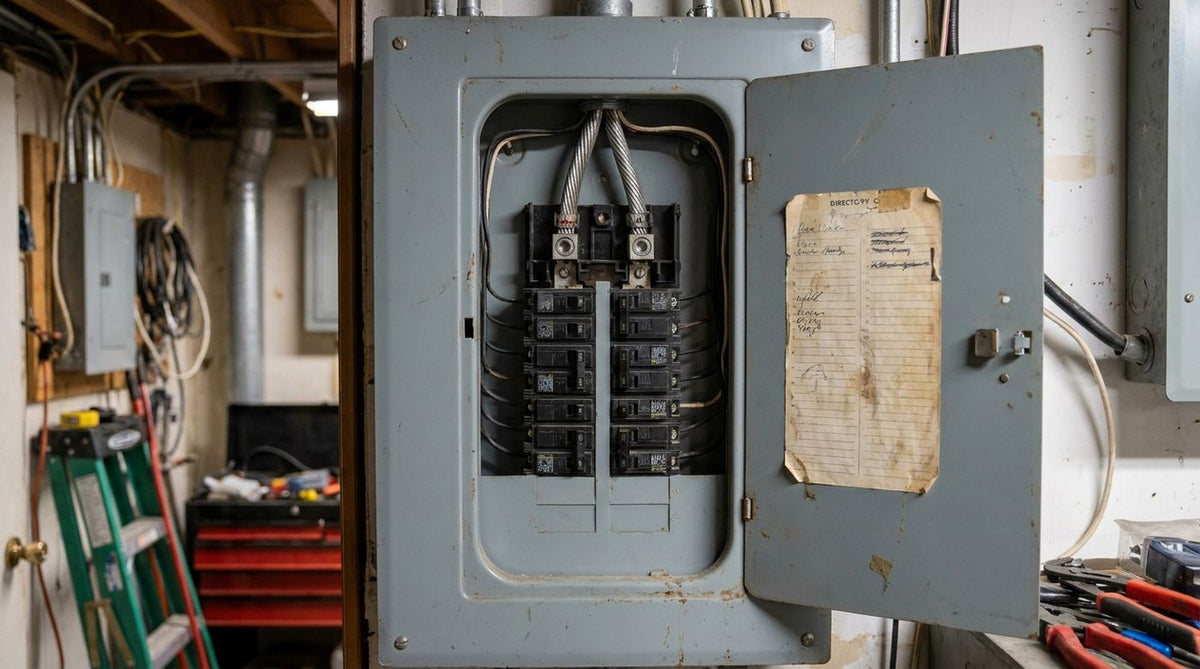
Somebody wants a 48 amp EV charger, or a heat pump, or a hot tub, on a house that was wired in 1991. The question you are being asked is whether the service can take it. The question most people answer instead is what the sticker inside the panel door says, which is not the same question and is frequently not even close.
The nameplate is a bus rating
The label inside a loadcenter tells you the maximum current the busbar assembly is listed to carry. It tells you nothing about the service. A 200 amp bus with a 100 amp main breaker in it is a 100 amp service. So is a 200 amp bus fed from a 100 amp meter main outside. So is a 200 amp panel fed with 2 AWG aluminum.
The actual service rating is the smallest link in a chain, and you have to look at each one:
- The rating of the service disconnecting means, wherever it physically is — which on older houses is sometimes in the meter socket outside, sometimes at the top of the panel, and occasionally is six throws of the hand in a fuse cabinet.
- The ampacity of the service-entrance conductors, read off the insulation and the conductor size at the lugs. Section 310.12 has the dwelling service and feeder table that governs this; the sizes in it changed with the 2020 cycle, so check which edition you are working under. IAEI's adoption table lists the enforced edition and effective date for every state.
- The meter socket rating, stamped on the socket, which is often the forgotten bottleneck on a 1960s house.
- Whatever the utility will actually serve at that location, which is a phone call, not a code question.
Write all four down before you quote anything. One of them will be smaller than the customer thinks.
The schedule is a claim, not evidence
Section 408.4 requires circuit directories to identify the purpose of each circuit clearly and specifically, and spares to be genuinely spare. In a house that has had three owners and two remodels, what you will typically find is a mix of the original builder's handwriting, one legible label from a kitchen job, and eleven entries that say "bedroom."
Treat it as a hypothesis. The only reliable way to know what a breaker feeds is to open it and find out what went dark, and the only reliable way to know what is on a multiwire branch circuit is to look at the handle ties and follow the neutral. This is unglamorous and it is the work. Budget two hours for a circuit trace on an older house and charge for it, because the alternative is discovering the shared neutral after you have landed the new load.
While you are in there, the survey is as much physical as it is arithmetic. Look at the panel brand, because some older lines have documented failure histories that change the conversation entirely. Look for double taps, for a neutral bar being used as a ground bar in a subpanel, for aluminum feeder terminations with no antioxidant and no evidence of a torque wrench, for scorching at a lug, for missing knockout seals and for a grounding electrode system that consists of a clamp on a water pipe that was replaced with PEX in 2006.
Anything you find in that panel becomes partly yours the moment you put your hands in it and do not write it down.
Measure the load instead of arguing about it
Here is the part that changes jobs. Article 220 gives you the standard calculation and the optional dwelling calculation, and both are estimates built from square footage and nameplates. They are deliberately conservative, because they have to cover a house whose occupants might all do everything at once. Applied to a real house with two adults and a gas range, they routinely say you need a service upgrade when you do not.
Section 220.87 is the alternative, and it is the most useful thing in the article for service work. It lets you determine the existing load from actual maximum demand data rather than from assumptions: either the maximum demand over a continuous one-year period, or, where a year of data is not available, recorded demand over a minimum 30-day period taken at 15-minute intervals and multiplied by 125 percent. You then add the new load to that figure and compare it against the service.
Two practical notes. First, the utility very often already has the data. Modern AMI meters record interval demand, and many utilities will provide twelve months of peak demand on request, free, in a day or two. That is the cheapest load study you will ever do. Second, if you are logging it yourself, the 30 days has to be the right 30 days. A recording ammeter on both legs at the service for the month of October in a house with electric heat and central air tells you nothing worth having. Log the season that loads the house hardest, or use the utility's annual peak.
When the measured number still does not leave room, load management is worth pricing before a service upgrade. Energy management systems under Article 750 and the EV supply equipment load management provisions in Article 625 exist precisely so that a 100 amp service does not automatically become a $6,000 job. Read the current text through NFPA's free access portal, which requires a free account, and check the edition your jurisdiction actually enforces, because this material has moved between cycles.
Why this is the part of the trade that fails people
Load calculation is where competent electricians reliably come unstuck, and there is a hard number on it. Texas publishes its licensing exam results, and in FY2025 the journeyman calculations paper had a pass rate of 20.56 percent. The master calculations paper was 19.08 percent. The journeyman exam overall ran at 27.52 percent, with 1,390 candidates passing out of 5,050. These are not people who cannot do arithmetic. They are people who never got a clear explanation of which method applies to which situation and why the demand factors are shaped the way they are.
The field version of the same gap is the contractor who quotes a service upgrade because the calculation said so, when thirty days of interval data would have said otherwise. That is real money taken off a customer who did not need to spend it, and it is an avoidable way to lose a referral.
Load calculations and the survey work behind them sit in Chapter 2, and they reward being learned once properly rather than looked up under pressure. Our Illustrated Guide to Understanding the National Electrical Code, Volume 1 works through Article 220 with the dwelling cases drawn out; if the exam is what is in front of you, the journeyman exam prep study guide covers the calculation paper specifically.