
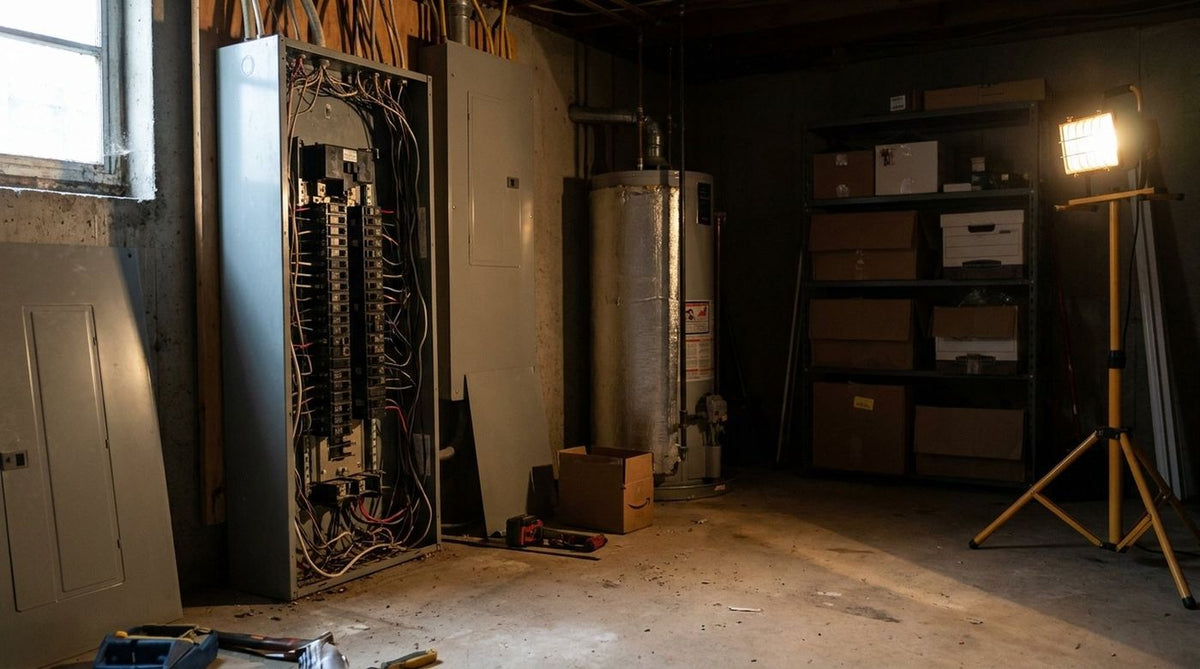
Every service call in an older house eventually produces the same moment. You open the utility room door and the panel is behind a water heater, a set of steel shelves, or eleven years of accumulated garage. Somebody put that stuff there because the wall was empty, and the wall was empty because the panel was on it.
Article 110.26 is the code's answer, and it is one of the few rules in the book written to protect the person rather than the building. Conductor sizing, overcurrent protection, box fill, derating — all of it is aimed at keeping the wire from starting a fire. Working space is aimed at keeping whoever is standing in front of the equipment alive long enough to walk out.
What the rule actually asks for
Three dimensions, plus a fourth thing that gets forgotten on nearly every remodel.
- Depth. Measured from the live parts out into the room, or from the enclosure front where the parts are enclosed. The required depth depends on nominal voltage to ground and on what is behind you. Table 110.26(A)(1) sorts that into three conditions, and Condition 3 — grounded or exposed live parts on both sides of the working space — asks for the most room. Read the table rather than remembering a single number, because the number changes above 150 volts to ground.
- Width. Thirty inches or the width of the equipment, whichever is greater. It does not have to be centered on the equipment, but the doors and hinged panels have to swing to at least ninety degrees inside it.
- Headroom. Six feet six inches, or the height of the equipment where the equipment is taller than that.
- Dedicated space. 110.26(E) governs the footprint directly above and below an indoor panelboard or switchboard, and it is a different rule from working space. Satisfying one does not satisfy the other. This is the rule that catches the plumber who ran a condensate line across the top of the panel and the HVAC tech who set a unit underneath it.
Two more subsections earn their keep and get read least. 110.26(C) covers entrance to and egress from the working space, and for large equipment it wants a way out at each end. 110.26(D) requires illumination for indoor service equipment, switchboards, panelboards and motor control centers — which is to say the code has already decided that holding a flashlight in your teeth is not a lighting plan.
Why the numbers are the numbers
The dimensions are not arbitrary and they are not about comfort. Depth is the distance you need to get your torso clear of the enclosure while your hands are still in it, and the distance a person needs to fall backward instead of into the gear. Width is two shoulders and a swung door. Headroom is standing up straight without your head in the gutter of a tall section.
The part that gets least discussion is that working space is also rescue space. A person in contact with an energized part cannot always let go, and the people who come for them are often the next casualty. NIOSH's summary of worker electrocutions, which reproduces the full text of 224 investigative reports, is a long catalog of jobs where nobody had anywhere to move.
Those deaths are not hypothetical for our trade. ESFI's compilation of workplace electrical fatality data for 2011 through 2024 puts the electrician fatality rate at 2.89 per 100,000 workers, against 0.11 across all occupations. That is the ratio the working-space rules are pushing against.
What a cramped space does
NIOSH investigated a 1994 North Carolina case in which an HVAC contractor and his employee both died. The job was setting a new unit and running duct in a crawl space under one end of a house. The report gives the crawl space height as 38 inches.
The employee, 23 years old, was driving screws through aluminum strapping into floor joists with an electric drill. The report describes the sharp edge of the strap contacting the house wiring and damaging its insulation, energizing the drill bit and the strap; the circuit completed through the worker and nearby pipes to ground. The homeowner heard noise and fetched the contractor, 46 years old, who went into the crawl space and took hold of the first man. He became part of the same circuit. Both died. The investigators' recommendations covered job-site hazard surveys, complete written safety programs, and training that includes rescue procedure. The full report is FACE 94-17.
That was not a 110.26 violation and nobody should pretend it was — it was HVAC work in a crawl space, not maintenance in front of a panelboard. It is on this page because it shows the mechanism the working-space rules are built around. Thirty-eight inches of height meant the first man had nowhere to go and the second man had no way to reach him without joining the circuit. Space is what turns a contact into a scare instead of a funeral.
What happens when the panel is boxed in
The obvious cost is the red tag, and it is usually the expensive kind, because fixing it means moving the water heater or moving the panel and neither is a morning's work. The inspector is not being difficult. Working space is one of the few violations that is still a violation years later, when nobody remembers who built the shelf.
The less obvious cost is what a boxed-in panel does to the next person's behavior. If you cannot get square to the deadfront, you work at an angle with one arm extended. If you cannot open the door to ninety degrees, you work around it. If you cannot get a light on it, you guess. None of those individually kills anyone. They are, however, exactly the conditions under which a person decides it is easier to leave the main on for one more minute.
The other thing to keep in mind is that OSHA is not neutral on this. 29 CFR 1910 Subpart S incorporates NEC requirements by reference in its own appendix, and that appendix is worth ten minutes of anyone's time. A working-space problem is not only a code problem on an inspection report; it is a condition an OSHA compliance officer can cite after somebody gets hurt.
If you want the working-space rules laid out with the conditions drawn rather than described, that is the kind of thing our Illustrated Guide to Understanding the National Electrical Code, Volume 1 is built for. The code text itself is available through NFPA's free access portal, which needs a free account.